


Anti-Defection Law Latest News
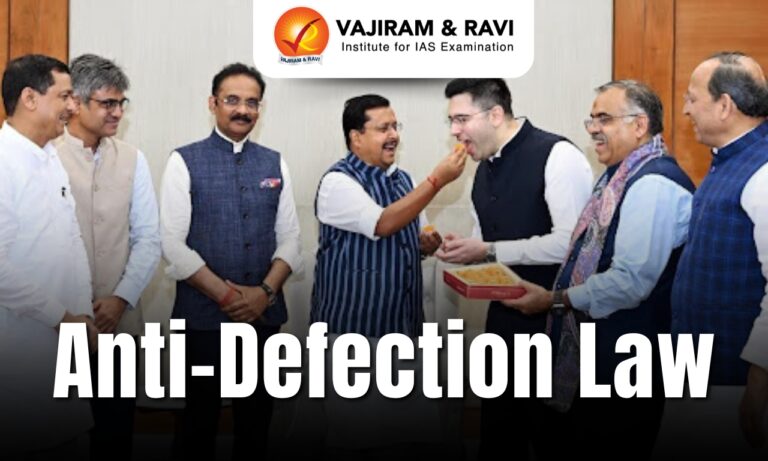
- Recently, seven of AAP’s ten Rajya Sabha members — including Raghav Chadha, who had been removed as the party’s deputy leader in the Upper House just weeks prior — announced their merger with the BJP.
- This development has reignited a long-standing constitutional debate around the Tenth Schedule of the Indian Constitution, popularly known as the Anti-Defection Law.
The Anti-Defection Law
- Enshrined through the 52nd Constitutional Amendment Act, 1985, the Tenth Schedule was enacted to curb floor-crossing — the practice of elected representatives switching parties for personal or political gain.
- A legislator faces disqualification if they:
- Voluntarily relinquish membership of the party on whose ticket they were elected, or
- Vote or abstain from voting against the directions of their party or authorised functionary.



Two Exceptions to Disqualification Under the Anti-Defection Law
- The split exception (Paragraph 3):
- Protected legislators from disqualification if at least one-third of the legislature party defected together.
- This was removed by the 91st Constitutional Amendment, 2003, owing to its systematic misuse to engineer defections.
- The merger exception (Paragraph 4):
- Still in force, this protects legislators who join another party as part of a genuine merger of their original party.
- Two sub-paragraphs govern this:
- Paragraph 4(1): A member is protected if the original political party merges with another.
- Paragraph 4(2): Such a merger is valid only if at least two-thirds of the legislature party consents to this merger.
- Significance of exceptions: The exception was intended, as reflected in parliamentary debates, to protect principled defections rooted in ideological differences.
The Legal Ambiguity
- The crux of the current controversy lies in how Paragraph 4‘s two sub-paragraphs are interpreted.
- Conjunctive vs disjunctive reading:
- Conjunctive: Both a national-level merger of the original party and two-thirds consent of the legislature party are required.
- Disjunctive: A “deemed merger” is triggered by two-thirds consent alone, even without a formal merger at the national party level.
Judicial Precedents
- Rajendra Singh Rana v. Swamy Prasad Maurya (2007):
- The Supreme Court, while interpreting the now-deleted split exception, endorsed a conjunctive reading.
- It held that a split in the legislature party must stem from a corresponding split in the original political party.
- Goa Congress Merger Case (2019–2022):
- Ten Congress MLAs in Goa joined the BJP, claiming they constituted two-thirds of the 15-member Congress legislature party.
- The Speaker upheld the merger; the Bombay High Court (February 2022) affirmed this, adopting a disjunctive reading.
- It ruled that a “deemed merger” occurs once two-thirds of a legislature party agrees to join another, without requiring national-level party approval.
Expert Opinions
- P.D.T. Achary (former Lok Sabha Secretary-General) — Conjunctive view:
- A valid merger requires the original party to first merge at the national level, followed by two-thirds support from the legislature party.
- In the AAP case, this would necessitate Arvind Kejriwal’s consent to a merger with the BJP.
- He noted that any member may now file a disqualification petition before the Rajya Sabha Chairman, whose ruling would be subject to judicial review.
- Vidhi Centre for Legal Policy — Disjunctive view with caveats:
- The two-thirds threshold being met could allow the move to qualify as a “deemed merger.”
- However, he flagged a deeper anomaly — Rajya Sabha MPs are elected by State MLAs, and the AAP MLAs in Punjab who elected these members continue to belong to AAP.
- This creates a disconnect between the electoral base and party affiliation of the MPs, undermining the very logic of Rajya Sabha representation.
Challenges
- Ambiguous drafting: For example, Paragraph 4 leaves room for contradictory judicial interpretations, which could be misused to legitimise opportunistic defections dressed up as mergers.
- Absence of the split exception post-2003: This means there is no explicit provision for partial defections, making the merger route the only legal pathway.
- Structural anomaly:
- MPs switch parties while the MLAs who elected them remain in the original party, weakening the principle of representative accountability.
- The Rajya Sabha Chairman, as the adjudicating authority, may face questions of political impartiality.
Way Forward
- Definitive ruling: The Supreme Court needs to end interpretive uncertainty on the conjunctive vs. disjunctive reading of Paragraph 4.
- Legislative clarification: Through a fresh constitutional amendment that explicitly defines the conditions for a valid merger.
- Structural reforms:
- Strengthening the independence of the presiding officer (Speaker/Chairman) in adjudicating disqualification petitions — or vesting such powers in an independent tribunal.
- This has been a long-standing reform recommendation of the Election Commission, the Dinesh Goswami Committee (1990) and the Law Commission’s 170th Report (1999).
Conclusion
- The AAP Rajya Sabha episode is not merely a political event — it is a constitutional stress test.
- It exposes the unresolved tension at the heart of the Tenth Schedule: whether the merger exception is a safeguard for principled ideological realignment or a loophole enabling opportunistic party-switching.
- The case is ripe for Supreme Court adjudication and legislative clarification. Until then, India’s anti-defection framework remains vulnerable to the very malaise it was designed to cure.
Source: TH

 Last updated on May, 2026
→ UPSC Prelims 2026 will be conducted on 24th May, 2026 & UPSC Mains 2026 will be conducted on 21st August 2026.
→ Prepare effectively with Vajiram & Ravi’s UPSC Prelims Test Series 2026 featuring full-length mock tests, detailed solutions, and performance analysis.
→ UPSC Final Result 2025 is now out.
→ UPSC has released UPSC Toppers List 2025 with the Civil Services final result on its official website.
→ Anuj Agnihotri secured AIR 1 in the UPSC Civil Services Examination 2025.
→ UPSC Notification 2026 & UPSC IFoS Notification 2026 is now out on the official website at upsconline.nic.in.
→ UPSC Calendar 2026 has been released.
→ Check out the latest UPSC Syllabus 2026 here.
→ The UPSC Selection Process is of 3 stages-Prelims, Mains and Interview.
→ Enroll in Vajiram & Ravi’s UPSC Mains Test Series 2026 for structured answer writing practice, expert evaluation, and exam-oriented feedback.
→ Join Vajiram & Ravi’s Best UPSC Mentorship Program for personalized guidance, strategy planning, and one-to-one support from experienced mentors.
→ Shakti Dubey secures AIR 1 in UPSC CSE Exam 2024.
→ Also check Best UPSC Coaching in India
Anti-Defection Law FAQs
Q1. What are the challenges in the implementation of the Anti-Defection Law?+
Q2. What is the ‘merger exception’ under the Tenth Schedule? +
Q3. What is the role of the Speaker/Chairman in deciding defection cases in India?+
Q4. How do defections by Rajya Sabha members raise concerns regarding representative democracy?+
Q5. What reforms are needed in India’s Anti-Defection Law?+
Tags: Anti defection law mains articles upsc current affairs upsc mains current affairs