



Kawasaki Disease Latest News
A multicenter study recently found that the addition of prednisolone to the conventional primary therapy for Kawasaki disease had no effect on lowering the number of cases of coronary-artery lesions at one month from the onset of the disease.
About Kawasaki Disease
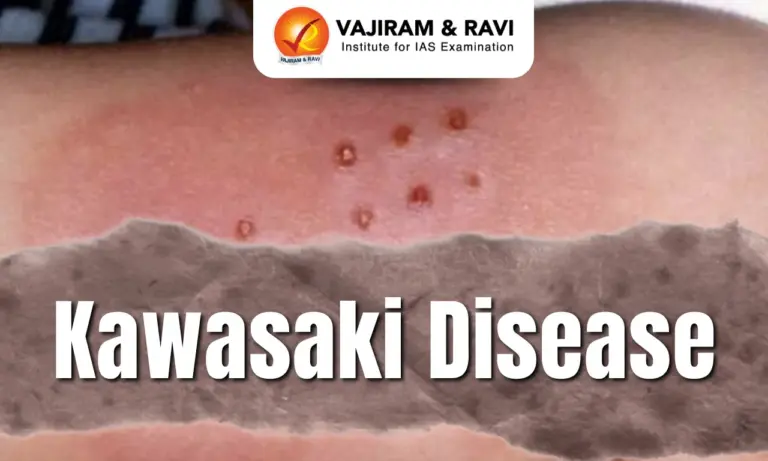
- Kawasaki Disease, also known as Kawasaki syndrome or mucocutaneous lymph node syndrome, is a rare disease that causes fever and inflammation of the blood vessels.
- It occurs mostly in children younger than 5 years old and affects boys more often than girls.
- The disease was first described in Japan by Tomisaku Kawasaki in 1967, and the first cases outside of Japan were reported in Hawaii in 1976.
- The cause of Kawasaki disease is unknown, although more cases happen in late winter and early spring.
- It is the most common form of acquired (not present at birth) heart disease in children in developed countries.
- The condition causes the immune system to attack blood vessels, which become inflamed and swollen.
- It tends to affect the coronary arteries, which carry blood to the heart muscle.
- It can also cause problems with lymph nodes, skin, and the lining of a child’s mouth, nose, and throat.
- It is not contagious, so it cannot spread from person to person.



Kawasaki Disease Symptoms
- Symptoms of Kawasaki disease can appear in two phases and may last several weeks.
- Common symptoms include:
- A high fever lasting more than five days.
- A rash on the main part of the body or in the genital area.
- An enlarged lymph node in the neck.
- Very red eyes without a thick discharge.
- Red, dry, cracked lips and a red, swollen tongue.
- Swollen, red skin on the palms of the hands and the soles of the feet. Later the skin on fingers and toes peels.
Kawasaki Disease Treatment
- It is often treatable. With early treatment, most children get better and have no long-lasting problems.
- It is usually treated in the hospital with an intravenous (IV) dose of immunoglobulin (IVIG) antibodies.
Source: MD

 Last updated on May, 2026
→ UPSC Prelims 2026 will be conducted on 24th May, 2026 & UPSC Mains 2026 will be conducted on 21st August 2026.
→ Prepare effectively with Vajiram & Ravi’s UPSC Prelims Test Series 2026 featuring full-length mock tests, detailed solutions, and performance analysis.
→ UPSC Final Result 2025 is now out.
→ UPSC has released UPSC Toppers List 2025 with the Civil Services final result on its official website.
→ Anuj Agnihotri secured AIR 1 in the UPSC Civil Services Examination 2025.
→ UPSC Notification 2026 & UPSC IFoS Notification 2026 is now out on the official website at upsconline.nic.in.
→ UPSC Calendar 2026 has been released.
→ Check out the latest UPSC Syllabus 2026 here.
→ The UPSC Selection Process is of 3 stages-Prelims, Mains and Interview.
→ Enroll in Vajiram & Ravi’s UPSC Mains Test Series 2026 for structured answer writing practice, expert evaluation, and exam-oriented feedback.
→ Join Vajiram & Ravi’s Best UPSC Mentorship Program for personalized guidance, strategy planning, and one-to-one support from experienced mentors.
→ Shakti Dubey secures AIR 1 in UPSC CSE Exam 2024.
→ Also check Best UPSC Coaching in India
Kawasaki Disease FAQs
Q1. What is Kawasaki Disease?+
Q2. Which age group is most affected by Kawasaki Disease?+
Q3. During which seasons are more cases of Kawasaki Disease observed?+
Q4. How does Kawasaki Disease affect the immune system?+
Q5. Which arteries are mainly affected in Kawasaki Disease?+
Tags: kawasaki disease prelims pointers upsc current affairs upsc prelims current affairs