



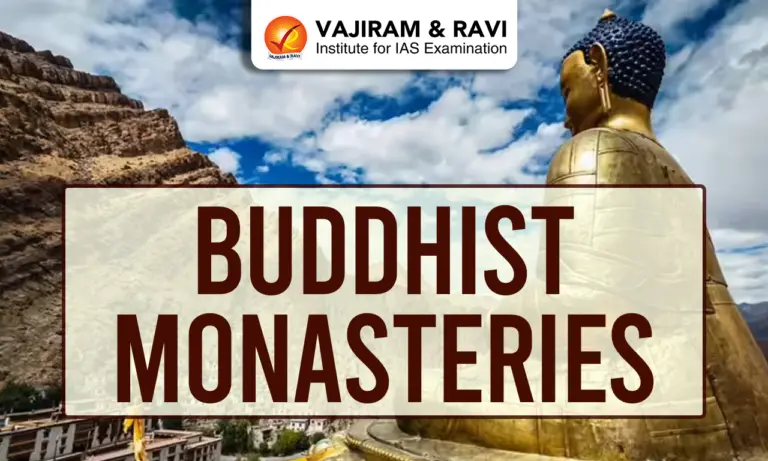
Buddhist Monasteries are sacred institutions where monks live under vows and follow disciplined spiritual practices within the Sangha system. These centres act as hubs of learning, meditation and cultural preservation. Across regions, Buddhist Temples reflect diverse architectural styles and traditions such as vihara, chaitya and stupa.
In India, Buddhist Monasteries hold historical importance as they trace the spread of Buddhism from ancient times while continuing to serve as places of worship, education and community welfare.
Buddhist Monasteries in India
Buddhist Monasteries in India reflect historical evolution, regional diversity and spiritual traditions while serving as centers of learning, meditation and cultural heritage. The list of major Buddhist Temples has been given below:
Hemis Monastery
- Location and affiliation: Hemis Monastery is a Drukpa lineage Tibetan Buddhist gompa located 45 km south of Leh on the Indus River‘s west bank in Ladakh, making it a key centre of Himalayan Buddhism.
- Cultural importance: It hosts the famous annual festival dedicated to Guru Padmasambhava in June-July, attracting large gatherings of devotees and tourists celebrating masked dances and rituals.
- Historical role: The monastery has long served as a spiritual hub promoting Buddhist teachings and preserving ancient traditions of the Drukpa sect in the region.
- Architectural features: Hemis Monastery showcases traditional Tibetan design with prayer halls, murals and sacred artefacts representing centuries old Buddhist artistic heritage.
Tabo Monastery
- Foundation details: Tabo Monastery in Spiti Valley was established in 996 CE by Rinchen Zangpo under the patronage of King Yeshe-O of the Guge kingdom.
- Historical significance: It is among the oldest continuously functioning Buddhist monasteries in India, often called the “Ajanta of the Himalayas” for its ancient murals.
- Cultural heritage: The monastery preserves rare wall paintings, manuscripts and sculptures reflecting early Tibetan Buddhist traditions and artistic excellence.
- Religious importance: Tabo has remained a major centre for Buddhist learning and meditation practices for over a millennium in the Himalayan region.
Tsuglakhang Monastery
- Location and identity: Tsuglakhang Monastery in Gangtok serves as a royal chapel and important Buddhist monastery associated with Sikkim’s spiritual traditions.
- Institutional role: It functions as a central place of worship and ceremonial activities linked to the region’s Buddhist governance and cultural life.
- Cultural importance: The monastery plays a key role in preserving rituals, festivals and monastic traditions followed in Sikkim.
- Architectural style: Its structure reflects traditional Buddhist palace style architecture with prayer halls, sacred images and ritual spaces.
Namgyal Monastery
- Establishment history: Founded by the Third Dalai Lama Gendun Gyatso around 1564-1565, Namgyal Monastery is located in McLeod Ganj, Dharamshala.
- Institutional significance: It serves as the personal monastery of the 14th Dalai Lama and represents all four major Tibetan monastic traditions.
- Religious importance: Renamed in 1571 after the deity Namgyälma, it focuses on rituals for longevity, protection and spiritual welfare.
- Monastic community: The monastery houses nearly 200 monks dedicated to advanced Buddhist studies and ceremonial practices.
Thiksey Monastery
- Location and sect: Thiksey Monastery belongs to the Gelug sect and is situated on a hill about 19 km east of Leh in Ladakh.
- Architectural uniqueness: The twelve storey complex resembles the Potala Palace of Lhasa and is one of the most visually striking monasteries in India.
- Cultural assets: It houses stupas, statues, thangkas, wall paintings and ancient artefacts showcasing Buddhist artistic richness.
- Religious role: Thiksey functions as a major centre for monastic education and spiritual training in the Ladakh region.
Tawang Monastery
- Geographic importance: Located in Arunachal Pradesh, Tawang Monastery is the largest monastery in India and second largest globally after Potala Palace.
- Historical significance: It has been a major centre of Mahayana Buddhism and monastic learning in the Eastern Himalayas for centuries.
- Cultural role: The monastery plays a vital role in preserving Buddhist traditions, festivals and rituals in the region.
- Institutional structure: It houses a large monastic community and extensive libraries of ancient scriptures.
Bylakuppe Monastery (Namdraling Monastery)
- Global importance: Located in Karnataka, it is the largest teaching centre of the Nyingma lineage of Tibetan Buddhism worldwide.
- Community size: The monastery supports a sangha of over 5,000 lamas, making it one of the largest monastic settlements globally.
- Educational facilities: It includes a school, religious college (shedra) and hospital, promoting holistic development.
- Cultural preservation: The monastery actively preserves Tibetan traditions, language and religious practices in exile.
Shashur Monastery
- Historical background: Built in the 17th century by Lama Deva Gyatsho, Shashur Monastery belongs to the Drugpa sect in Himachal Pradesh.
- Political link: It was established under the influence of Bhutan’s ruler Nawang Namgyal, showing regional religious connections.
- Cultural role: The monastery is known for its traditional festivals and mask dances reflecting Buddhist teachings.
- Religious significance: It continues to serve as a centre for meditation and monastic learning.
Ghum Monastery
- Establishment: Founded in 1875 by Lama Sherab Gyatso, Ghum Monastery is located in West Bengal.
- Sect affiliation: It belongs to the Gelukpa or Yellow Hat sect of Tibetan Buddhism.
- Unique feature: The monastery houses a 15 foot high statue of Maitreya Buddha, symbolizing the future Buddha.
- Cultural importance: It is a key spiritual centre in eastern India attracting pilgrims and tourists alike.
Kye Gompa Monastery
- Location and altitude: Situated at 4,166 metres in Spiti Valley, Kye Gompa is the largest monastery in the region.
- Institutional role: It serves as a major training centre for lamas and Buddhist scholars.
- Strategic position: Built on a hilltop near the Spiti River, it reflects defensive monastic architecture.
- Cultural importance: The monastery preserves ancient scriptures, paintings and religious traditions.
Dhankar Monastery
- Geographic location: Located at 3,894 metres in Lahaul and Spiti, Dhankar Monastery is among the highest monasteries globally.
- Historical role: It served as the capital of Spiti in the 17th century and an administrative centre.
- Religious importance: The monastery has been a major centre of Buddhist learning since the 7th century.
- Architectural uniqueness: Built on a cliff, it reflects remarkable adaptation to harsh terrain.
Lingdum Monastery
- Location: Lingdum Monastery is situated near Ranka in Sikkim, about an hour from Gangtok.
- Sect affiliation: It follows the Zurmang Kagyu tradition of Tibetan Buddhism.
- Cultural role: The monastery promotes Buddhist teachings and rituals in northeastern India.
- Educational importance: It serves as a centre for training monks and preserving traditions.
Alchi Gompa Monastery
- Historical origin: Built between 958 and 1055 AD by Rinchen Zangpo, Alchi Monastery is one of Ladakh’s oldest sites.
- Administrative link: It is managed by Likir Monastery, maintaining its religious significance.
- Artistic value: Known for ancient murals and sculptures, it represents early Indo-Tibetan art.
- Cultural importance: It stands as a major heritage site reflecting Buddhist artistic excellence.
Phugtal Monastery
- Remote location: Situated in Zanskar’s Lungnak Valley, Phugtal Monastery is accessible only by foot.
- Unique structure: Built around a natural cave, it reflects early monastic traditions.
- Historical belief: The cave is believed to have been visited by sages and scholars over 2,500 years ago.
- Spiritual importance: It remains an isolated centre for meditation and spiritual practice.
Shankar Monastery
- Location: Shankar Monastery is located near Leh in Ladakh.
- Institutional link: It is a branch of Spituk Monastery and residence of Kushok Bakula.
- Religious role: It serves as an important centre for Buddhist teachings in Ladakh.
- Cultural importance: The monastery maintains continuity of monastic traditions.
Matho Monastery
- Location and sect: Matho Monastery lies 26 km southeast of Leh on the Indus River and belongs to the Sakya order.
- Foundation: It was established in the 16th century by Lama Tugpa Dorjay.
- Cultural importance: Known for its annual festival featuring oracles and masked dances.
- Religious role: It continues to function as a centre for spiritual learning.
Nako Monastery
- Establishment: Founded in 996 AD by Rinchen Zangpo, Nako Monastery is located in Kinnaur district.
- Historical importance: It is one of the oldest monasteries on ancient Himalayan trade routes.
- Cultural heritage: The monastery preserves ancient Buddhist art and manuscripts.
- Religious role: It remains a centre for monastic practices.
Rumtek Monastery
- Identity: Rumtek Monastery, also called Dharmachakra Centre, is located near Gangtok in Sikkim.
- Historical origin: Built under the direction of the 12th Karmapa in the mid 18th century.
- Religious importance: It is a key centre of the Kagyu lineage of Tibetan Buddhism.
- Institutional role: The monastery functions as a major centre of learning and spiritual practice.
Pemayangtse Monastery
- Establishment: Founded in 1647 by Lama Lhatsun Chempo, it is located near Pelling in Sikkim.
- Historical importance: It is one of the oldest monasteries in Sikkim.
- Cultural role: Known for preserving pure monastic traditions of Tibetan Buddhism.
- Religious significance: It serves as a premier monastery in the region.
Gonjang Monastery
- Establishment: Gonjang Monastery was founded in 1981 by Tingkye Gonjang Rimpoche in Sikkim.
- Cultural importance: It contributes to the spread of Buddhist teachings in the region.
- Religious role: The monastery functions as a place for meditation and learning.
- Institutional relevance: It reflects modern expansion of monastic institutions.
Karzok Buddhist Monastery
- Location: Situated near Korzok village on Tso Moriri lake in Ladakh.
- Historical origin: Founded around 300 years ago by Kunga Lodro Ningpo.
- Geographic importance: Located near one of the highest lakes in the world.
- Religious role: It serves the local nomadic community’s spiritual needs.
Bharatpur Buddhist Monastery Complex
- Archaeological discovery: Excavations in Paschim Bardhaman revealed a large monastery complex with brick structures and pottery remains.
- Historical context: The site links to earlier discoveries from 1972-75 including a large stupa.
- Cultural significance: Findings indicate spread of Buddhism in southwestern Bengal during ancient times.
- Unique importance: Presence of Black and Red Ware Pottery suggests coexistence of religious and settlement activities.
Buddhist Monasteries Across World
Buddhist Monasteries across the world show cultural diversity, architectural evolution and religious traditions shaped by regional history while preserving core teachings.
- Borobudur, Central Java, Indonesia: Built in the 8th century under the Sailendra Dynasty, Borobudur is the world’s largest Buddhist temple, designed as a mandala with intricate reliefs reflecting Buddhist cosmology and spiritual journey.
- Batujaya Stupas, Karawang, West Java, Indonesia: This ancient complex dates from the 2nd to 12th centuries, representing one of Indonesia’s earliest Buddhist archaeological sites with numerous stupas reflecting early spread of Buddhism.
- Muaro Jambi Temple Complex, Jambi, Sumatra, Indonesia: A major Buddhist heritage site associated with the Srivijaya empire, it consists of extensive temple ruins showing the region’s importance in Buddhist learning and trade networks.
- Sewu Temple, Central Java, Indonesia: An 8th century Buddhist temple complex near Prambanan, it reflects advanced temple architecture and was influenced by powerful Hindu-Buddhist kingdoms of ancient Java.
- Kinkaku-ji Temple, Kyoto, Japan: A UNESCO World Heritage Site, this Buddhist temple is famous for its golden pavilion structure and reflects Japan’s integration of Buddhist philosophy with aesthetic architectural design.
- Nara Buddhist Temples, Nara, Japan: Nara hosts some of Japan’s oldest and most significant Buddhist temples, developed when Buddhism became state religion in the 8th century, influencing Japanese culture and governance.
- Kyoto Buddhist Temples, Kyoto, Japan: Kyoto contains a dense concentration of historic temples forming the cultural heartland of Japanese Buddhism with architectural features like main halls and associated Shinto shrines.
- Wat Benchamabophit, Bangkok, Thailand: Known as the Marble Temple, it represents classic Thai wat architecture with distinct divisions between Phutthawat for Buddha and Sangkhawat for monastic community.
- Thai Wat Temples, Thailand: Buddhist monasteries in Thailand follow a structured layout with designated sacred and monastic zones, reflecting organized religious life and architectural uniformity across the country.
- Jetavanaramaya, Anuradhapura, Sri Lanka: Once among the tallest structures in the ancient world, this massive stupa highlights Sri Lanka’s advanced engineering and its strong Buddhist heritage.
- Ruwanwelisaya Stupa, Anuradhapura, Sri Lanka: One of the largest stupas globally, it symbolizes the deep rooted Buddhist traditions of Sri Lanka and its historical role as a major religious centre.
- Abhayagiri Vihara, Anuradhapura, Sri Lanka: A major monastic complex in ancient Sri Lanka, it served as a centre for Buddhist scholarship and attracted monks from across Asia.
- Jaya Sri Maha Bodhi, Anuradhapura, Sri Lanka: Known as the oldest human planted tree still living, it is a sacred Bodhi tree grown from the original tree under which Buddha attained enlightenment.
- Khosheutovsky Khurul, Russia: Built in 1818, it reflects a blend of Buddhist and Russian architectural traditions with cruciform design and features adapted to cold climate conditions.
- Buryat Datsans, Russia: These Buddhist monasteries combine local and Russian influences, often built in square or pyramid forms with Chinese style roofs, reflecting cultural synthesis in architecture.
- Kalmyk Khuruls, Russia: Constructed using wood and stone, these monasteries show adaptation of Buddhist architecture to regional conditions while maintaining spiritual functions and symbolic layouts.



 Last updated on May, 2026
→ UPSC Prelims 2026 will be conducted on 24th May, 2026 & UPSC Mains 2026 will be conducted on 21st August 2026.
→ Prepare effectively with Vajiram & Ravi’s UPSC Prelims Test Series 2026 featuring full-length mock tests, detailed solutions, and performance analysis.
→ UPSC Final Result 2025 is now out.
→ UPSC has released UPSC Toppers List 2025 with the Civil Services final result on its official website.
→ Anuj Agnihotri secured AIR 1 in the UPSC Civil Services Examination 2025.
→ UPSC Notification 2026 & UPSC IFoS Notification 2026 is now out on the official website at upsconline.nic.in.
→ UPSC Calendar 2026 has been released.
→ Check out the latest UPSC Syllabus 2026 here.
→ The UPSC Selection Process is of 3 stages-Prelims, Mains and Interview.
→ Enroll in Vajiram & Ravi’s UPSC Mains Test Series 2026 for structured answer writing practice, expert evaluation, and exam-oriented feedback.
→ Join Vajiram & Ravi’s Best UPSC Mentorship Program for personalized guidance, strategy planning, and one-to-one support from experienced mentors.
→ Shakti Dubey secures AIR 1 in UPSC CSE Exam 2024.
→ Also check Best UPSC Coaching in India
Buddhist Monasteries FAQs
Q1. What are Buddhist Monasteries?+
Q2. Which is the largest Buddhist Monastery in India?+
Q3. Which is the oldest Buddhist Monastery in India?+
Q4. Which monastery is located at the highest altitude?+
Q5. Which Buddhist Monastery is known for the Guru Padmasambhava festival?+
Tags: art and culture art and culture notes buddhist monasteries