




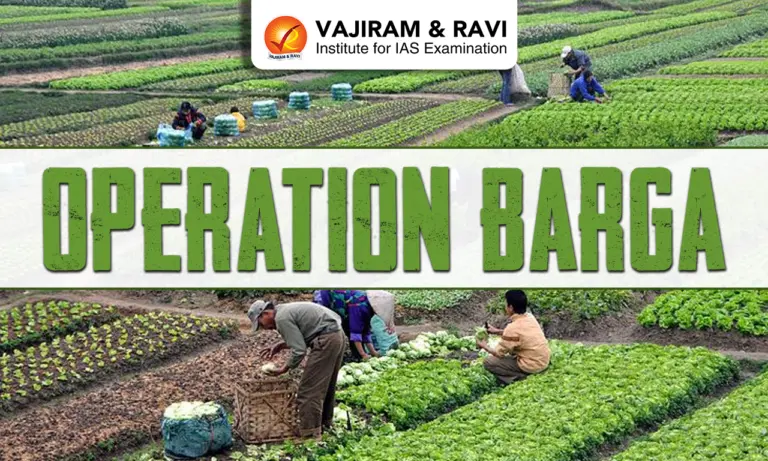
Operation Barga was a land reform initiative aimed at helping small farmers and sharecroppers who worked on land owned by others. Before this, many such farmers had little security and could be removed from the land easily, often receiving an unfair share of the produce. The program focused on giving these farmers recognition and protection, so they could work without fear and get a fairer share of what they produced. In a simple sense, it was an effort to make the agricultural system more just, improve farmers’ lives, and reduce exploitation in rural areas.
About Operation Barga
- Operation Barga was a land reform program started in the 1970s in West Bengal under the leadership of Jyoti Basu and the Left Front government. It was introduced to improve the lives of small farmers and sharecroppers who worked hard on land but did not legally own it.
- Before this initiative, many farmers had very little security. They could be removed from the land at any time and often had to give a large part of their harvest to landowners. Operation Barga aimed to change this situation by giving these farmers legal recognition and protection, so they could work with dignity and a sense of stability.
Operation Barga Main Goals
- Security for Farmers: The program ensured that tenant farmers and sharecroppers were officially recorded, giving them protection from eviction and more control over the land they cultivated.
- Fair Distribution of Land: It was part of a larger effort to reduce inequality by limiting the power of big landowners and making land distribution more balanced.
- Better Farming and Productivity: When farmers felt secure, they were more motivated to improve the land, which helped increase agricultural production.
- Reducing Exploitation: The system helped protect poor farmers from unfair practices, such as high rents and forced dependence on landlords.



Operation Barga Working
- Survey and Identification: The government carried out surveys to find out who was actually farming the land. Many people had been cultivating land for years without any official recognition. These farmers were identified and brought into the system.
- Recording the Farmers’ Rights: Once identified, their names were officially recorded in government records. This gave them legal recognition as sharecroppers, which meant they could no longer be easily removed from the land.
- Security of Land Tenure: After being registered, farmers gained a sense of security. They were allowed to continue farming the same land without fear of eviction, and landlords could not replace them at will.
- Fair Share and Control: The system also ensured that farmers received a fairer share of the produce. With more control over their work, they were able to make better decisions about farming and improve their livelihoods.
- Long-term Stability: Over time, this process reduced the power imbalance between landlords and farmers. It helped create a more stable and fair rural system where farmers could plan for the future instead of living with constant uncertainty.
Operation Barga Significance
Operation Barga had a deep and lasting impact on rural life in West Bengal. It was not just about land it was about dignity, fairness, and giving farmers a better future.
- Empowering Farmers and Reducing Exploitation: Before this reform, many farmers depended completely on landlords and lived with constant insecurity. Operation Barga gave them legal rights and recognition, which meant they could no longer be easily pushed out. This reduced unfair treatment and gave farmers more control over their work and lives.
- Improving Agricultural Productivity: When farmers feel secure, they naturally take better care of the land. With rights over the land they cultivated, farmers became more willing to invest time and effort in improving farming methods. This led to better crop production and healthier agricultural growth.
- Reducing Poverty and Inequality: The reform helped bridge the gap between rich landowners and poor farmers. By giving rights to sharecroppers and landless workers, it created opportunities for a more stable and dignified life, helping reduce rural poverty.
- Strengthening the Rural Economy: With more secure livelihoods, farming families became more stable. This reduced the need for migration to cities in search of work. As a result, villages became economically stronger and more self-reliant.
- A Model for Other Regions: Operation Barga showed that meaningful land reforms are possible. Its success inspired other regions to think about similar steps to protect farmers and make agriculture more equitable.
- Social and Political Change: The reform also changed the social structure in rural areas. It weakened old systems where power was concentrated in the hands of a few landlords and moved towards a more equal and just society. At the same time, it built strong trust between the government and rural communities.
Operation Barga Challenges
Even though Operation Barga was an important reform, it was not easy to implement and faced several difficulties, especially in West Bengal.
- Resistance from Landowners: Many big landowners were unhappy with the reforms because they feared losing control over their land and power. In some places, this led to conflicts and tensions, and farmers sometimes faced pressure or threats.
- Problems with Land Records: Accurate land records were not always available. In many cases, ownership details were unclear or outdated. This made it difficult to correctly identify who was cultivating the land, leading to confusion and disputes.
- Illegal Occupation and Disputes: There were situations where land was already occupied unofficially or claimed by multiple people. Sorting out these issues took time and created hurdles in giving clear rights to the actual farmers.
- Gaps in Implementation: Although the policy was strong on paper, its execution was not always smooth. Some farmers were left out, and in certain areas, the process of registration and recognition was slow or incomplete.
- Administrative and Awareness Issues: Many farmers were not fully aware of their rights or how to claim them. At the same time, local officials sometimes faced limitations in managing such a large reform program effectively.
Operation Barga Legacy and Long-Term Effects
Operation Barga left a lasting impact on rural life in West Bengal and continues to be remembered as an important step toward fairness in agriculture.
- Reduced Problems Faced by Farmers: By giving farmers security over the land they cultivated, the reform helped reduce everyday struggles like fear of eviction and unstable income. This brought a sense of relief and stability to many farming families.
- Boost to Rural Development: The changes created a strong base for future rural and agricultural development. With better security and income, villages saw improvements in living conditions, farming practices, and local economies.
- Better Social and Economic Status: When farmers received legal rights over land, their position in society improved. They were no longer just laborers but recognized landholders, which gave them confidence, dignity, and financial security.
- Long-Term Political Impact: The reform helped build strong trust between rural people and the government. Because farmers directly benefited from these changes, the ruling government was able to maintain support for many years.
- A Step Toward Social Justice: Beyond economics, Operation Barga helped reduce inequality in rural areas. It slowly weakened old systems where power was concentrated in a few hands and moved society toward a more fair and balanced structure.

 Last updated on May, 2026
→ UPSC Prelims 2026 will be conducted on 24th May, 2026 & UPSC Mains 2026 will be conducted on 21st August 2026.
→ Prepare effectively with Vajiram & Ravi’s UPSC Prelims Test Series 2026 featuring full-length mock tests, detailed solutions, and performance analysis.
→ UPSC Final Result 2025 is now out.
→ UPSC has released UPSC Toppers List 2025 with the Civil Services final result on its official website.
→ Anuj Agnihotri secured AIR 1 in the UPSC Civil Services Examination 2025.
→ UPSC Notification 2026 & UPSC IFoS Notification 2026 is now out on the official website at upsconline.nic.in.
→ UPSC Calendar 2026 has been released.
→ Check out the latest UPSC Syllabus 2026 here.
→ The UPSC Selection Process is of 3 stages-Prelims, Mains and Interview.
→ Enroll in Vajiram & Ravi’s UPSC Mains Test Series 2026 for structured answer writing practice, expert evaluation, and exam-oriented feedback.
→ Join Vajiram & Ravi’s Best UPSC Mentorship Program for personalized guidance, strategy planning, and one-to-one support from experienced mentors.
→ Shakti Dubey secures AIR 1 in UPSC CSE Exam 2024.
→ Also check Best UPSC Coaching in India
Operation Barga FAQs
Q1. What is Operation Barga?+
Q2. Who started Operation Barga and when?+
Q3. What were the main objectives of Operation Barga?+
Q4. How did Operation Barga work?+
Q5. Why was Operation Barga important?+
Tags: economy economy notes operation barga