New Consumer Price Index – Changes and Implications

New Consumer Price Index

Consumer Price Index Latest News

  • The Ministry of Statistics and Programme Implementation (MoSPI) has released a new India Consumer Price Index (CPI) series with 2024 as the base year, reporting retail inflation at 2.75% in January. 

Understanding the Consumer Price Index in India

  • The Consumer Price Index (CPI) is the primary measure of retail inflation in India. 
  • It tracks changes in the prices of goods and services consumed by households and is used by the Reserve Bank of India (RBI) to frame monetary policy under the inflation-targeting framework.
  • CPI reflects the cost of living and directly affects interest rates, wages, pensions, and government welfare schemes. 
  • It is based on a “basket” of goods and services that represents typical household consumption patterns.
  • Since consumption habits change over time due to income growth, technological shifts, and urbanisation, the CPI basket must be periodically revised. 
  • Without such revisions, the index may misrepresent actual inflation trends.

Key Features of the New CPI Series

  • Updated Base Year
    • The base year has been revised to 2024. A base year acts as a reference point against which price changes are measured. 
    • Updating it ensures that inflation calculations reflect contemporary consumption patterns rather than outdated ones.
  • Revised Consumption Basket
    • The new CPI includes goods and services that households currently consume and excludes obsolete items. 
    • For example, older items such as CDs and DVDs have been replaced with modern electronics such as headphones, earphones, and Bluetooth devices. 
    • This reflects the digital transformation of Indian households and makes inflation measurement more realistic.
  • Retail Inflation in January
    • According to the new CPI series, retail inflation stood at 2.75% in January. 
    • However, direct comparison with previous months under the old CPI series is statistically inappropriate due to differences in basket composition and methodology.

The Apples-to-Oranges Problem

  • One major issue raised by analysts is the comparability of inflation rates under the old and new series.
  • Under the old CPI, December inflation was recorded at 1.33%. Comparing that figure directly with January’s 2.75% under the new series would be misleading because:
    • Some goods have been added or removed.
    • Weightages assigned to categories have changed.
    • Data sources and price collection methods have been revised.
  • This is similar to comparing two different baskets of goods; the underlying components differ, so inflation outcomes may vary even if price trends remain stable.

The Back-Series Debate

  • To address comparability concerns, MoSPI has released a “back-series” of headline index numbers going back to 2013. 
  • However, experts caution that this back-series is largely mechanical. It applies linking factors to adjust old data, but does not reconstruct the old basket using new consumption patterns.
  • For example, December 2025 inflation under the new series would be 1.17%, compared to 1.33% under the old series. 
  • Over 2025, the average inflation rate remains broadly similar at around 2.2% under both series. 
  • Yet, economists argue that a more detailed back-series requires deeper methodological work, especially given changes in:
    • Item inclusion and exclusion
    • Market coverage
    • Data collection processes

Changes in the Weight of Food, Gold and Silver

  • Reduced Weight of Food
    • Food items now carry a lower weight in the CPI basket compared to the previous series. 
    • This reflects rising incomes and diversification of household expenditure towards services and non-food items.
    • A lower food weight could potentially reduce volatility in headline inflation, as food prices are typically more sensitive to monsoon conditions and supply shocks.
  • Revised Weight of Gold and Silver
    • In the old CPI, gold had a weight of 1.08% and silver 0.11%. 
    • In the new CPI, gold/diamond/platinum jewellery together account for 0.62%, while silver jewellery accounts for 0.31%. 
    • Although their combined weight remains important, gold’s individual weight has reduced.
    • Interestingly, global gold and silver prices saw sharp increases — gold inflation at 69% and silver at 97% during December 2025. 
  • If these were excluded, CPI inflation in December 2025 would have been just 0.26% instead of 1.33%. 
  • This shows how commodity price shocks can significantly influence headline inflation.

Implications for Monetary Policy

  • The new CPI series has several policy implications:
    • Improved Accuracy - It better reflects actual household spending patterns.
    • Reduced Food Volatility - Lower food weight may stabilise headline inflation.
    • Core Inflation Insight - With changed weights, underlying (core) inflation trends may appear softer.
    • Better Policy Calibration - RBI decisions on repo rates can be more aligned with real consumption dynamics.
  • However, transitional confusion and data interpretation challenges may persist until a detailed back-series is prepared.

Source: IE

[youtube url="https://www.youtube.com/watch?v=T3gWqdVUJyQ" width="560" height="315"]

Consumer Price Index FAQs

Q1: What is the base year of the new CPI series?

Ans: The new CPI series uses 2024 as its base year.

Q2: What was retail inflation in January under the new CPI?

Ans: Retail inflation stood at 2.75% in January.

Q3: Why cannot the new CPI be directly compared with the old series?

Ans: Because the consumption basket, weights, and methodology have changed.

Q4: How has the weight of gold changed in the new CPI?

Ans: Gold/diamond/platinum jewellery now accounts for 0.62% compared to 1.08% for gold earlier.

Q5: How did gold and silver prices affect inflation in December 2025?

Ans: Excluding gold and silver, inflation would have been 0.26% instead of 1.33%.
Right to Vote – Understanding Its Legal Status and Constitutional Evolution in India

Right to Vote Latest News

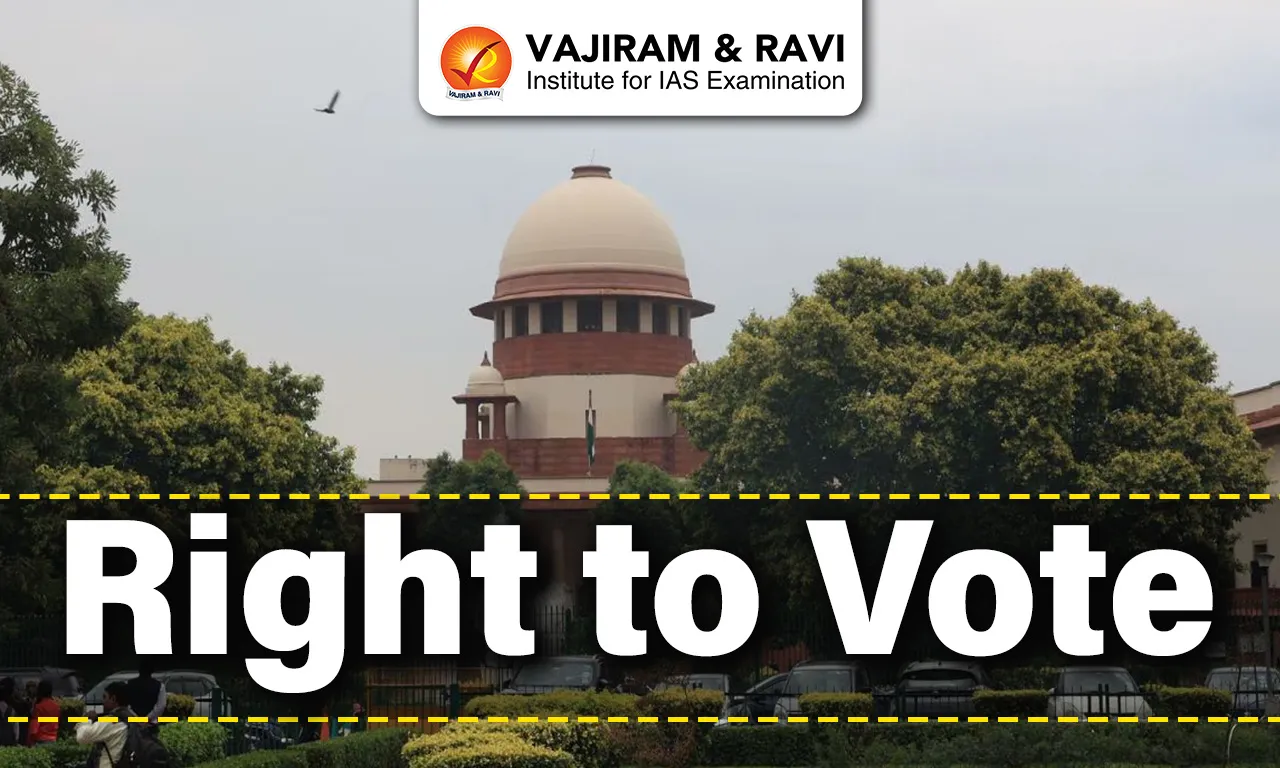
  • The Supreme Court is hearing cases filed against the Special Intensive Revision (SIR) of electoral rolls in Bihar.

Introduction

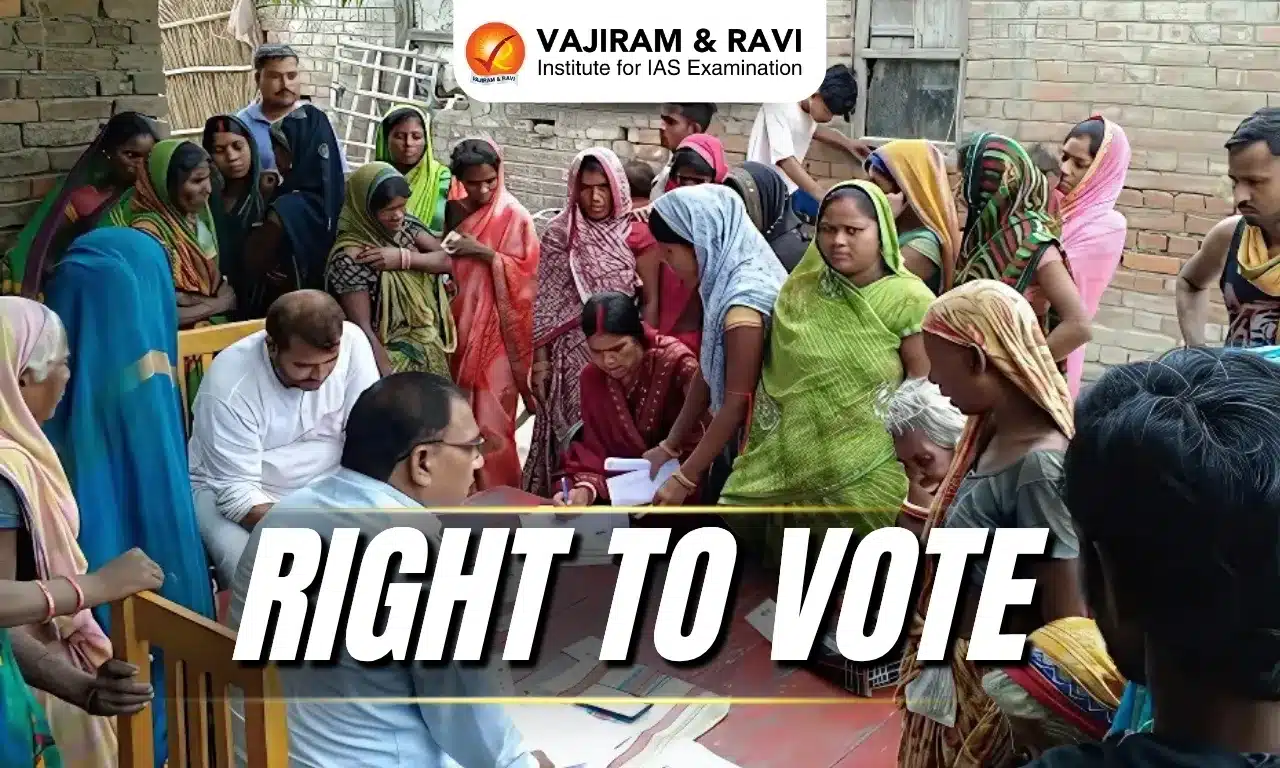
  • The Supreme Court of India is presently examining petitions related to the Special Intensive Revision (SIR) of electoral rolls in Bihar. 
  • This has reignited an important legal question: What is the true legal status of the right to vote in India?
  • Although the right to vote is fundamental to the functioning of a democracy, Indian jurisprudence has oscillated between categorising it as a constitutional right and a statutory one. 
  • The debate has implications not just for electoral integrity but also for how citizen rights are interpreted and enforced.

Classifying Rights in the Indian Legal Framework

  • India recognises different classes of rights under its constitutional and legal regime:
    • Natural Rights: Inherent and inalienable, such as the right to life and liberty. While not directly enforceable, courts may interpret these through fundamental rights.
    • Fundamental Rights: Enshrined in Part III of the Constitution, they include rights such as freedom of speech, equality before the law, and protection from discrimination. These are enforceable under Article 32.
    • Constitutional Rights: Located outside Part III but within the Constitution, such as the right to property and trade. These are enforceable through Article 226 or relevant legal processes.
    • Statutory Rights: Derived from ordinary laws passed by Parliament or State legislatures, such as the right to work under MGNREGA or the right to food under the National Food Security Act.
  • The status of the right to vote, though derived from the Constitution, has largely been interpreted as a statutory right, setting the stage for the ongoing debate.

Constitutional and Legal Provisions on Voting

  • The Constitution of India, under Article 326, guarantees universal adult franchise, stating that every citizen aged 18 or above is entitled to vote, provided they are not disqualified under law. This mandate is operationalised through two key legislations:
  • Representation of the People Act, 1950 (RP Act, 1950):
    • Section 16 disqualifies non-citizens from being enrolled in electoral rolls.
    • Section 19 requires voters to be ordinarily resident and aged 18 or more on the qualifying date.
  • Representation of the People Act, 1951 (RP Act, 1951):
    • Section 62 allows voting for all enrolled individuals unless disqualified by law or imprisoned.
  • These laws form the statutory framework for voting, leading to the view that the right to vote is not absolute but subject to legislative qualifications.

Judicial Interpretation Over the Years

  • The status of the right to vote has been clarified, and contested, across several landmark judgments:
    • N.P. Ponnuswami (1952): The Supreme Court held that the right to vote is purely statutory.
    • Jyoti Basu (1982): Reaffirmed that voting is neither a fundamental nor a common law right, but a statutory one.
    • PUCL Case (2003): Justice P.V. Reddy observed that even if not fundamental, the right to vote could be considered a constitutional right.
    • Kuldip Nayar (2006): The Supreme Court reverted to viewing voting as a statutory right.
    • Raj Bala (2015): Recognised it as a constitutional right based on earlier PUCL interpretation.
    • Anoop Baranwal (2023): Majority opinion once again concluded that the right to vote is statutory.
  • These oscillations reflect the court’s balancing act between textual interpretation and evolving democratic principles.

The Dissenting View and Future Possibility

  • In the Anoop Baranwal case, one of the judges, in his dissent, presented a nuanced position. He argued that:
    • Voting is an expression of choice protected under Article 19(1)(a), freedom of speech and expression.
    • Free and fair elections are intrinsic to the basic structure of the Constitution.
    • Although shaped by statutory law, the origin of this right lies in Article 326 of the Constitution.
  • His reasoning could lay the foundation for a future judicial reconsideration that may elevate voting to the status of a constitutional right, particularly as jurisprudence around electoral rights and democratic accountability deepens.

Implications of the Current Legal Status

  • Statutory Nature: Being a statutory right means Parliament can impose reasonable restrictions, such as disqualifications or procedural changes.
  • Limited Enforcement: The right cannot be enforced through Article 32 like fundamental rights; redressal is through regular legal channels.
  • Need for Clarity: In an era of increasing voter suppression concerns, digital disenfranchisement, and electoral roll errors, the legal status of voting may impact how robustly the right is protected.

Source: TH

Right to Vote FAQs

Q1: What is the current legal status of the right to vote in India?

Ans: The right to vote in India is presently recognised as a statutory right under laws enacted by Parliament.

Q2: Which constitutional article underpins the right to vote?

Ans: Article 326 of the Constitution provides for universal adult suffrage in India.

Q3: Can the right to vote be enforced under Article 32 of the Constitution?

Ans: No, since it is not a fundamental right, it cannot be enforced directly under Article 32.

Q4: Which laws operationalise the right to vote in India?

Ans: The Representation of the People Act, 1950 and 1951 govern voter eligibility and electoral procedures.

Q5: Has the Supreme Court ever recognised voting as a constitutional right?

Ans: In some cases like PUCL and Raj Bala, courts acknowledged it as a constitutional right, but the prevailing view remains that it is statutory.

Film Piracy in India – Legal Provisions and Enforcement Challenges

Film Piracy

Film Piracy Latest News

  • The leak of the Tamil film Jana Nayagan before its theatrical release has highlighted legal and enforcement challenges related to film piracy in India.

Film Piracy and Its Nature

  • Film piracy refers to the unauthorised copying, distribution or sharing of copyrighted audio-visual content such as movies and web series. It can occur through:
    • Illegal downloads and torrent platforms. 
    • Sharing via messaging apps and cloud links. 
    • Recording in theatres or leaking from production pipelines. 
  • The recent case is significant because the film was leaked in high quality even before its theatrical release, indicating internal access misuse. 

Legal Framework on Film Piracy in India

  • India has a multi-layered legal framework to address piracy.
  • Copyright Act, 1957
    • The Copyright Act forms the primary legal basis for protecting creative works.
    • Section 63 provides for imprisonment up to 3 years. 
    • It also allows fines up to Rs. 2 lakh. 
    • Section 63A deals with repeat offenders, imposing similar penalties for each violation. 
    • The Act covers films, books, music and other intellectual property.
  • Cinematograph Act, 1952 (Amended in 2023)
    • The 2023 amendment strengthened anti-piracy provisions.
    • It introduces a penalty of up to 5% of the audited gross budget of the film. 
    • This significantly increases financial deterrence for piracy. 
    • In high-value productions, this can result in extremely large fines.

Enforcement Challenges in India

  • Despite strong laws, enforcement remains weak.
    • India is often labelled a “notorious market” for piracy due to limited enforcement action. 
    • Investigations are rarely pursued rigorously. 
    • Legal action often targets distributors rather than individual infringers. 
  • However, in the current case, strong political and industry support may lead to stricter enforcement. 

Scope of Liability in Piracy Cases

  • Liability in piracy is not limited to the original leaker.
    • Individuals who forward links can also face penalties. 
    • Cloud sharing and digital dissemination expand the chain of liability. 
    • Early recipients of leaked content may face harsher punishment. 
  • This reflects the evolving nature of digital piracy, where distribution networks are decentralised.

Mechanisms Used by Studios to Prevent Piracy

  • Restricted Access and Encryption
    • Films are distributed to theatres in encrypted formats. 
    • Access is limited to authorised personnel only. 
  • Digital Rights Management (DRM)
    • OTT platforms use DRM technologies to prevent copying. 
    • However, advanced piracy tools can bypass DRM protections. 
  • Watermarking Techniques
    • Invisible and visible watermarks are embedded in film prints. 
    • These help identify the source of a leak. 
    • This acts as a strong deterrent for insiders.

Post-Leak Response Measures

  • Once a film is leaked, complete removal is nearly impossible.
  • Key challenges include:
    • Constantly changing piracy websites. 
    • Distribution through torrents and encrypted messaging platforms. 
    • Rapid replication across multiple platforms. 
  • However, studios still attempt mitigation through:
    • Copyright takedown notices to platforms. 
    • Collaboration with anti-piracy firms such as AiPlex. 
    • Blocking of infringing websites. 

Judicial Tools to Combat Piracy

  • Courts have developed innovative legal tools.
    • Dynamic injunctions: Allow continuous blocking of new piracy links. 
    • John Doe orders: Issued in anticipation of piracy even before release. 
  • These tools enhance proactive enforcement.

Source: TH | TH

Film Piracy FAQs

Q1: What is film piracy?

Ans: It is the unauthorised copying and distribution of films and other copyrighted content.

Q2: What punishment is prescribed under the Copyright Act?

Ans: Up to 3 years imprisonment and a fine of Rs. 2 lakh.

Q3: What is the key change in the Cinematograph Act amendment?

Ans: A penalty of up to 5% of the film’s audited budget.

Q4: Can sharing pirated links also be punished?

Ans: Yes, even forwarding links can attract legal penalties.

Q5: What are dynamic injunctions?

Ans: Court orders that allow continuous blocking of piracy websites and links.

Right to Vote vs Right to Contest: How Right to Vote Impacts Elections in SIR Row

Right to Vote

Right to Vote Latest News

  • The Supreme Court of India denied interim relief to over 34 lakh individuals removed from electoral rolls in West Bengal after the SIR exercise, barring them from voting in upcoming elections.
  • The case underscores the tension between procedural integrity and individual electoral rights, raising concerns about how voter exclusion can directly affect democratic participation and candidacy.

Background: Contrasting Case Outcomes

  • Case of C. Geetha (Tamil Nadu)
    • C. Geetha filed her nomination on April 2, 2026 and began campaigning as an independent candidate. 
    • She later discovered her name had been deleted from the electoral roll, allegedly after officials skipped her house during the SIR exercise.
    • The Election Commission of India (ECI) stated the challenge was filed too late, as:  Nominations had closed; Electoral rolls were already frozen. 
      • Inclusion was only possible via a supplementary list, which requires a prior tribunal order.
    • The Supreme Court rejected her plea on April 10, upholding the ECI’s position.
  • Case of Motab Shaikh (West Bengal)
    • Motab Shaikh, an INC candidate, had his name deleted due to inconsistencies in records. He appealed promptly.
    • The appellate tribunal examined documents (Aadhaar, passport, driving licence, family records) and confirmed his identity. It ordered his name to be added to the supplementary list the same day.
    • The contrasting outcomes highlight how delays in appeal and rigid electoral procedures can determine eligibility, raising concerns about fairness and due process in large-scale voter deletions.

Court’s Position on Voting Rights

  • The Court described the right to vote as a key expression of citizenship and patriotism. It refused to allow excluded individuals to vote while their appeals are pending, citing procedural consistency and fairness.

Reasoning Behind the Decision

  • Allowing excluded voters to vote could create precedent-based complications.
  • It may lead to similar demands from those challenging voter inclusions, disrupting electoral integrity.
  • The Court emphasised consistency in electoral processes.

Broader Electoral Implications

  • The ruling highlights the strict linkage between inclusion in electoral rolls and voting rights.
  • Individuals excluded from rolls lose immediate electoral participation, even if their appeals are ongoing.
  • The situation highlights a key issue: pending appeals do not restore voting rights, leaving both voters and candidates in legal limbo during elections.

Impact on Candidates

  • A key concern arises for candidates whose names are deleted from voter rolls. 
  • Such individuals face uncertainty, as their eligibility to contest elections is tied to their status as registered voters.
  • The controversy underscores a critical democratic dilemma: the right to vote directly affects the right to contest elections, raising questions about fairness, timing, and due process in electoral roll management.

Legal and Procedural Constraints

  • Supplementary List Requirement - Under Rule 23(5) of the Registration of Electoral Rules, 1960, names can be added only after a tribunal allows the appeal. Without such a decision, no immediate correction is possible.
  • No Interim Relief During Appeals - Rule 23(3) does not allow temporary restoration of names while appeals are pending. Courts cannot order inclusion mid-process, even if sympathetic.
  • Procedural Deviations in SIR Exercise - The appellate process showed deviations from Rules 19 and 20, which require: Prior notice; Opportunity to be heard before deletion.

Right to Vote vs Right to Contest: Legal Distinction

  • Not Fundamental Rights - The Supreme Court, in Ram Chandra Choudhary v Roop Nagar Dugdh Utpadak Sahakari Samiti Ltd (2024), reiterated that neither the right to vote nor the right to contest elections is a fundamental right, but both are statutory in nature.
  • Key Distinction Between the Two Rights - The right to vote allows a person to exercise franchise as per the statutory framework. The right to contest is a separate and additional right, subject to eligibility conditions, qualifications, and disqualifications. 
  • Eligibility vs Disqualification - Eligibility is a threshold condition required to enter the electoral process. Lack of eligibility is not a punishment, but merely delays participation until conditions are fulfilled. This is distinct from disqualification, which carries legal consequences.

Implications for Candidates in SIR Deletions

  • Loss of Elector Status - Candidates whose names were removed from electoral rolls under the SIR exercise are not legally disqualified, but they lose their status as electors, which is essential to contest elections.
  • Legal Requirement Under Election Law - Under the Representation of the People Act, a candidate must be registered as a voter in any constituency within the relevant State to be eligible to contest.

Judicial Precedents Reinforcing the Principle

  • In Jyoti Basu v Debi Ghosal, the Supreme Court held that the right to contest is purely statutory.
  • In K Krishna Murthy v Union of India, it affirmed that political participation rights are subject to statutory limitations.

Emerging Concern: Scale of Administrative Impact

  • While the legal framework is well established, the current situation is unusual due to the large-scale administrative deletions under SIR, which have affected candidates who were often unaware of their exclusion.
  • The issue highlights how loss of voter registration, even without formal disqualification, effectively bars candidates from contesting, raising concerns about procedural fairness and electoral participation.

Source: IE

Right to vote FAQs

Q1: What is the SIR controversy in West Bengal?

Ans: The SIR controversy involves deletion of over 34 lakh voters from electoral rolls, raising concerns about voting rights and its impact on electoral participation.

Q2: Is the right to vote a fundamental right?

Ans: The right to vote is not a fundamental right but a statutory right, governed by election laws and subject to conditions like inclusion in electoral rolls.

Q3: How does the right to vote affect contesting elections?

Ans: The right to vote determines eligibility to contest, as candidates must be registered voters. Without this, they cannot legally contest elections.

Q4: Why did courts deny interim relief to excluded voters?

Ans: Courts denied relief due to procedural constraints, as electoral rules do not allow temporary restoration of voting rights while appeals are pending.

Q5: What are the broader implications of SIR deletions?

Ans: SIR deletions raise concerns about due process, fairness, and democratic participation, as large-scale exclusions can affect both voting rights and candidacy eligibility.

Minimum Wage Crisis: Why Minimum Wage Gap is Driving Worker Protests in India

Minimum Wage

Minimum Wage in Mandis Latest News

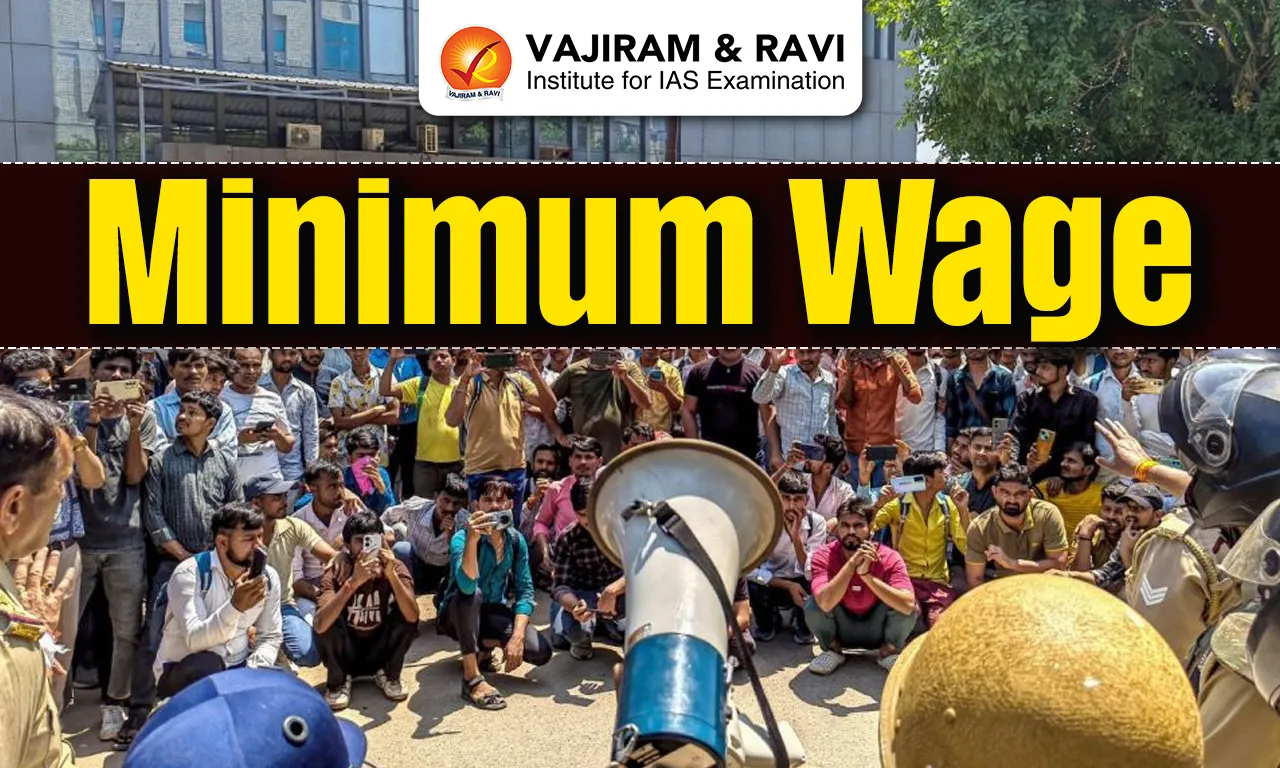
  • Thousands of factory workers in Noida protested—turning violent—over demands for minimum wage hikes, better working conditions, and overtime pay, amid rising living costs.
  • The immediate trigger was a 35% minimum wage hike in Haryana following protests in Manesar. Workers in neighbouring regions demanded similar wage revisions, sparking unrest in Noida.
  • The protests reflect growing distress due to rising living expenses, especially amid the West Asia war-induced inflation. Workers argue that wages have not kept pace with increasing costs of living.

Delay in Minimum Wage Revisions

  • Minimum wage has two components: 
    • Base wage – Revision supposed to take place every five years 
    • Cost of living allowance [Consumer Price Index-Industrial Workers (CPI-IW) linked] - This variable component is supposed to be revised twice a year.
  • However, base wage revisions have been delayed significantly: 
    • Haryana revised after 10 years 
    • Uttar Pradesh last revised in 2012, now offering only interim hikes
  • While most states carried out half-yearly revisions, they have missed out on the base minimum wage revisions, especially in the years after Covid-19.
  • The protests highlight a widening gap between inflation-driven expenses and delayed wage revisions, underscoring structural issues in India’s wage policy and labour welfare system.

Rising Cost of Living and Worker Distress

  • According to CPI-IW data (base year 2016), inflation for industrial workers rose by 24.8% nationally between February 2021 and February 2026. 
    • In key industrial regions, inflation was even higher—27.9% in Gurugram, 27.2% in Faridabad, and 27.4% in Ghaziabad, Noida, and Delhi.
  • However, minimum wage growth has not kept pace with rising prices: Haryana (rose only 15%); Uttar Pradesh (rose 24.6%); Delhi (rose only 20.6%).
  • This mismatch shows that real incomes of workers have declined, especially in Delhi-NCR.
  • Rising input costs due to US tariffs and disruptions like the Strait of Hormuz crisis have strained industries. This has led to delayed wage payments and job insecurity for workers.

Rising Household Expenses for Workers

  • Workers, many of whom are migrants, face increasing living costs:
    • LPG cylinders in black markets costing up to ₹4,000 
    • Rising room rents and food prices
  • These pressures have significantly worsened their financial burden.
  • The widening gap between inflation and wage growth, combined with industrial and global disruptions, has intensified economic stress for workers, fuelling protests and labour unrest.

Labour Codes and Worker Expectations

  • A key concern among protesting workers in Noida and Manesar was the expectation of higher wages following the notification of the four Labour Codes in November 2025. 
  • However, no such uniform wage increase materialised. 
  • Claims of a ₹20,000 minimum wage were clarified by the Uttar Pradesh government as misleading, since such rates applied only to central sphere establishments, not all factories.
  • The confusion stemmed from a 2024 Union government release indicating ₹783 per day (₹20,358 per month) for unskilled workers in certain sectors. 
  • Workers interpreted this as a universal minimum wage, while in reality, state-level rules determine wages for most establishments.

Uncertainty in Implementation of Labour Codes

  • The four labour codes—Code on Wages, Code on Social Security, Industrial Relations Code, and Occupational Safety, Health and Working Conditions (OSH) Code—came into effect in November 2025.
  • However, final rules are yet to be notified by the Centre and most states. Draft rules were issued in December 2025, creating uncertainty.

Working Hours and Flexibility Debate

  • The new codes define 8 hours per day and 48 hours per week, aligned with international norms.
  • However, daily work hours, rest intervals, and spread-over limits are yet to be formally specified.
  • This flexibility allows employers to introduce models like 12-hour shifts with extended weekly breaks, but has led to confusion and potential overwork.

Shift from Earlier Legal Framework

  • Under the Factories Act, 1948, daily working hours were capped at 9 hours, and spread-over hours at 10.5 (extendable to 12). 
  • The new codes shift regulatory power from Parliament to the executive, allowing states to decide details through rules. 

Concerns Raised by Experts and Workers

  • Risk of Exploitation - Experts argue that flexibility without clear safeguards is being misused by employers, leading to longer working hours in some sectors.
  • Lack of Uniformity Across States - Since states will notify their own rules: There may be regional disparities in wages and working conditions; Implementation may vary widely, creating confusion for workers and employers alike.
  • Weakening of Collective Bargaining - The new codes leave trade union recognition and collective bargaining largely to states, raising concerns about lack of a credible and uniform process for labour reforms.
  • While the Labour Codes aim to simplify regulations and standardise labour practices, delayed implementation, lack of clarity, and excessive flexibility have created confusion, unmet expectations, and concerns about worker protection.

Source: IE | ToI

Minimum Wage FAQs

Q1: Why are workers protesting in India?

Ans: Workers are protesting due to minimum wage stagnation, rising inflation, delayed wage revisions, and worsening living conditions, especially in industrial hubs like Noida and Manesar.

Q2: What are the components of minimum wage?

Ans: Minimum wage consists of base wage, revised every five years, and cost-of-living allowance linked to CPI-IW, revised twice yearly to reflect inflation trends.

Q3: How has inflation impacted workers?

Ans: Inflation for industrial workers rose sharply, but minimum wage growth lagged behind, reducing real incomes and increasing financial stress among workers in Delhi-NCR regions.

Q4: What role do labour codes play in protests?

Ans: Labour codes created expectations of higher minimum wage and better conditions, but delays in implementation and unclear rules caused confusion and dissatisfaction among workers.

Q5: What structural issues does the protest highlight?

Ans: The protests highlight delayed minimum wage revisions, policy gaps, weak labour protection, rising costs, and lack of uniform implementation across states.

VB–G RAM G Bill 2025 Explained: How It Replaces MGNREGA

VB–G RAM G Bill

VB–G RAM G Bill Latest News

  • The Viksit Bharat–Guarantee for Rozgar and Ajeevika Mission (Gramin) - VB-G Ram G- Bill, 2025 proposes a sweeping overhaul of India’s two-decade-old rural employment system by replacing MGNREGA, 2005
  • While positioned as a modernised framework for rural jobs and livelihoods, critics contend that the Bill could significantly increase the financial and administrative burden on state governments, raising concerns over its feasibility and federal implications.

Key Changes Proposed by the VB–G RAM G Bill

  • The Viksit Bharat–Guarantee for Rozgar and Ajeevika Mission (Gramin) Bill, 2025 proposes a fundamental restructuring of India’s rural employment guarantee by replacing the MGNREGA, 2005. 
  • The following are the five most consequential statutory changes, with relevant sections and clauses.

Expansion of Guaranteed Employment Days - [Section 3(1), VB–G RAM G Bill | Section 3(1), MGNREG Act]

  • The Bill guarantees 125 days of wage employment per rural household per financial year, up from “not less than 100 days” under MGNREGA.
  • Under MGNREGA, 100 days became a de facto ceiling due to NREGA software constraints, despite legal flexibility.
  • Existing provisions under Section 3(4) of MGNREGA allowed:
    • Additional 50 days in drought or disaster-notified areas.
    • 150 days for certain Scheduled Tribe households in forest areas.
  • VB–G RAM G makes 125 days the standard statutory entitlement, rather than an exception triggered by special circumstances.

Change in Centre–State Funding Pattern - [Section 22(2), VB–G RAM G Bill]

  • A major departure from MGNREGA, where the Centre paid 100% of unskilled wage costs.
  • Proposed cost-sharing under VB–G RAM G:
    • 90:10 (Centre:State) for Northeastern States, Himalayan States, and UTs with legislature (Uttarakhand, Himachal Pradesh, J&K).
    • 60:40 for all other States and UTs with legislature.
    • 100% Central funding for UTs without legislature.
  • This shifts direct wage liability to States, substantially increasing their fiscal responsibility.
  • Under MGNREGA, States were primarily responsible only for:
    • Unemployment allowance
    • ¼ of material costs
    • State-level administrative expenses

Normative Allocation Replaces Labour Budget - Sections 4(5) & 4(6), VB–G RAM G Bill

  • Section 4(5): Central Government shall determine State-wise normative allocation for each financial year based on prescribed objective parameters.
    • Normative allocation is a system where a central authority sets fixed, principled limits (norms) for funding or resource distribution to states/regions, shifting from demand-driven models.
  • Section 4(6): Any expenditure beyond this allocation shall be borne by the State Government.
  • Normative allocation” is defined as the Central fund allocation to a State.
  • This replaces the Labour Budget mechanism under MGNREGA, where:
    • States submitted annual work plans and labour budgets by January 31.
    • Funding was demand-driven and open-ended.
  • Effectively converts a rights-based, demand-led scheme into a budget-capped, supply-driven programme.

Statutory Pause During Peak Agricultural Seasons - Section 6(1) & Section 6(2), VB–G RAM G Bill

  • Section 6(1): No work shall be commenced or executed during notified peak agricultural seasons.
  • Section 6(2): States must notify, in advance, a period aggregating to 60 days per financial year covering sowing and harvesting.
  • Notifications may vary by:
    • Districts
    • Blocks
    • Gram Panchayats
    • Agro-climatic zones and local cropping patterns
  • All planning and execution authorities are legally bound to ensure works occur only outside these periods.
  • While addressing farm labour shortages, this reduces the effective window to realise the 125-day guarantee.

Viksit Gram Panchayat Plans & National Infrastructure Stack - Schedule I, VB–G RAM G Bill

  • All works must originate from Viksit Gram Panchayat Plans, consolidated upward:
    • Gram Panchayat → Block → District → State
  • These are aggregated into the Viksit Bharat National Rural Infrastructure Stack, aligned with national priorities.
  • The Stack covers four thematic domains:
    • Water security (water-related works)
    • Core rural infrastructure
    • Livelihood-related infrastructure
    • Extreme weather mitigation works
  • Plans will be integrated with the PM Gati Shakti National Master Plan, enabling spatial optimisation and inter-departmental convergence.

Rationale Behind the Proposed Overhaul of MGNREGA

  • The government argues that an overhaul was necessary as MGNREGA, enacted in 2005, no longer reflects current rural realities. 
  • With declining poverty levels and expanded digital access, the scheme has continued to face structural issues such as misuse of funds, weak monitoring, and creation of low-quality assets. 
  • In FY 2024–25, misappropriation amounted to ₹193.67 crore, while only 7.61% of households completed the full 100 days of work. 
  • The proposed VB–G RAM G framework seeks to replace this fragmented approach with a more focused, accountable, and technology-driven rural employment system.

Expected Impact of VB–G RAM G on the Rural Economy

  • The government argues that the new law will strengthen rural employment, incomes, and infrastructure. 
  • By prioritising water-related works, rural roads, markets, and climate-resilient assets, the scheme aims to raise agricultural productivity and reduce distress migration. 
  • Digitised planning, payments, and monitoring are expected to improve efficiency, transparency, and delivery.

What It Means for Farmers

  • Farmers are expected to benefit in multiple ways:
    • Improved labour availability during peak sowing and harvesting, as States can pause public works for up to 60 days.
    • Lower wage inflation during critical agricultural seasons.
    • Better water and irrigation infrastructure, enhancing farm resilience.
    • Improved rural connectivity and storage facilities, reducing post-harvest losses.

Gains for Rural Workers

  • For workers, the government highlights:
    • 25% increase in guaranteed employment days (125 days instead of 100).
    • Digital wage payments and Aadhaar-based verification, reducing delays and wage theft.
    • Mandatory unemployment allowance if work is not provided.
    • Creation of durable community assets such as roads and water systems.
    • Predictable job availability through panchayat-led planning.

Stronger Accountability and Monitoring

  • To address past weaknesses, the Bill introduces robust accountability mechanisms:
    • AI-based fraud detection systems
    • GPS and mobile-based monitoring of works
    • Weekly public disclosures of scheme data
    • Twice-yearly social audits at the gram panchayat level
    • Central and State-level steering committees for oversight

Source: IE | BT | MB

VB–G RAM G Bill FAQs

Q1: What is the VB–G RAM G Bill, 2025?

Ans: The VB–G RAM G Bill proposes replacing MGNREGA with a restructured rural employment framework featuring higher guaranteed days, funding caps, seasonal pauses, and digital governance.

Q2: How does the Bill change employment guarantees?

Ans: It raises guaranteed wage employment to 125 days per rural household annually, compared to 100 days under MGNREGA, making the higher limit a statutory entitlement.

Q3: How does funding under VB–G RAM G differ from MGNREGA?

Ans: Unlike MGNREGA’s fully Central wage funding, the new Bill introduces Centre–State cost sharing and normative allocations, shifting significant financial responsibility to States.

Q4: What is the provision for pausing work during agricultural seasons?

Ans: Sections 6(1) and 6(2) allow States to suspend work for up to 60 days during sowing and harvesting to ensure farm labour availability.

Q5: What accountability mechanisms are introduced?

Ans: The Bill mandates AI-based fraud detection, GPS monitoring, Aadhaar-linked payments, weekly disclosures, biannual social audits, and Central–State steering committees.

FCRA Amendment Bill 2026: FCRA Amendment Bill 2026 Key Changes and Kerala Controversy Explained

FCRA Amendment Bill 2026

FCRA Amendment Bill 2026 Latest News

  • The Union government has deferred discussion on the FCRA Amendment Bill, 2026, which was introduced in the Lok Sabha recently. 
  • The Bill proposes changes to the Foreign Contribution (Regulation) Act, 2010, aimed at regulating foreign funds to ensure they do not harm national interest, public order, or security.
  • However, the Bill has triggered controversy, with Opposition parties alleging it could adversely impact minority institutions, especially Christian organisations
  • The issue has gained political significance ahead of the Kerala Assembly elections, with strong opposition from both the ruling Left and the Congress in the state.

About FCRA

  • The Foreign Contribution (Regulation) Act (FCRA) is a law that regulates the acceptance and use of foreign funds by individuals, NGOs, and associations in India to ensure they do not affect national interest.
  • FCRA was first introduced in 1976 amid concerns that foreign entities were influencing India’s internal affairs through funding. 
  • It aimed to ensure organisations operate in line with the values of a sovereign democratic republic.
  • The Act has been amended three times (2016, 2018, 2020) to strengthen oversight.
  • The most significant changes came in 2020, which increased government control and scrutiny over how NGOs receive and utilise foreign funds.

FCRA 2010: Consolidated Framework

  • Key Objectives - A revised law was enacted in 2010 to consolidate regulations on foreign funding and prevent its misuse for activities harmful to national interest.
  • Registration Requirement - NGOs, associations, and individuals must obtain registration or prior permission to receive foreign contributions.
  • Permitted Uses - Foreign funds can be used only for specified purposes: Cultural; Economic; Educational; Social; Religious.

Scale of Foreign Funding

  • Around 16,000 organisations are registered under FCRA.
  • They collectively receive about ₹22,000 crore annually in foreign contributions.

Why the Amendment is Proposed

  • The government argues that the current law lacks a comprehensive framework for handling assets when FCRA registration lapses.
  • Key issues cited include:
    • Multiple investigations and inconsistent penalties 
    • No clear timelines for utilisation of funds 
    • Ambiguity in handling assets during suspension 
    • Lack of clarity on cessation of registration

FCRA Amendment Bill 2026: Key Changes

  • The FCRA Amendment Bill, 2026 proposes a major structural change by introducing a “designated authority” appointed by the Union government. 
    • This replaces Section 15 of the existing Act, aiming to address gaps in managing foreign-funded assets.
  • The designated authority will take over, supervise, and manage foreign contributions and assets if an organisation’s FCRA registration is:
    • Cancelled 
    • Surrendered 
    • Expired or not renewed 
  • A registration will be deemed expired if:
    • No renewal application is filed 
    • Renewal is denied 
    • Renewal is not obtained before expiry

Return or Permanent Takeover of Assets

  • If an organisation later gets its registration renewed or reissued, the authority may return unutilised funds and assets.
  • Assets can be permanently taken over if:
    • Registration is not renewed or restored within a specified period 
    • The organisation becomes defunct or ceases to exist 
  • In such cases, assets may be:
    • Transferred to government bodies (Centre, State, or local) 
    • Sold or disposed of through prescribed processes
  • Special Provision for Religious Institutions - Under Clause 16A(7), if the asset is a place of worship, the authority can assign its management to another person, ensuring that its religious character is preserved.
  • Religious and civil society groups argue that the amendment could threaten the functioning of minority institutions and NGOs that depend on foreign funding for social, educational, and charitable work.

Why the FCRA Amendment Bill is Controversial

  • The FCRA Amendment Bill, 2026 has triggered a political and social debate over its implications for NGOs and religious institutions, especially regarding government control over foreign-funded assets.

Government’s Justification

  • Addressing Legal and Operational Gaps - The Union government argues that the amendment is necessary to fix gaps in handling cases where FCRA registration is cancelled, surrendered, or expires.
  • Security Concerns - The Bill targets entities with “ill intentions”, particularly those allegedly using foreign funds for forced religious conversions.

Opposition’s Concerns

  • Risk of Asset Takeover - Opposition parties warn that if an NGO’s renewal application is delayed or rejected, its registration could lapse, allowing the designated authority to take control of its assets.
  • Fear of Excessive Government Control - Critics argue this provision could place NGOs and charitable organisations at the mercy of the Union government, reducing their autonomy.

The Kerala Factor in the FCRA Controversy

  • The debate over the FCRA Amendment Bill, 2026 has intensified in Kerala, especially with the Assembly elections scheduled for April 9, giving the issue strong political significance.
  • As per the 2011 Census, Kerala has a population of over 3.34 crore, with Christians forming the second-largest minority at more than 61 lakh people. This makes them a crucial voter base in the state.

Source: IE | IT

FCRA Amendment Bill 2026 FAQs

Q1: What is the FCRA Amendment Bill 2026?

Ans: The FCRA Amendment Bill 2026 proposes changes to regulate foreign funding, including creating a designated authority to manage NGO assets when registrations lapse.

Q2: What is the key change in the FCRA Amendment Bill 2026?

Ans: The main change in the FCRA Amendment Bill 2026 is the creation of a designated authority to control and manage foreign-funded assets of NGOs.

Q3: Why is the FCRA Amendment Bill 2026 controversial?

Ans: The FCRA Amendment Bill 2026 is controversial because critics fear it allows government control over NGO assets, especially affecting minority and charitable organisations.

Q4: Why is Kerala important in the FCRA Amendment Bill 2026 debate?

Ans: Kerala is significant because of its large Christian population and upcoming elections, making the FCRA Amendment Bill 2026 politically sensitive.

Q5: What concerns have opposition raised about the FCRA Amendment Bill 2026?

Ans: Opposition leaders argue the FCRA Amendment Bill 2026 could harm NGO autonomy and place charitable organisations under excessive government control.

Delimitation and Women’s Reservation Bills – A Structural Reset of India’s Electoral Framework

Delimitation and Women's Reservation Bills

Delimitation and Women’s Reservation Bill Latest News

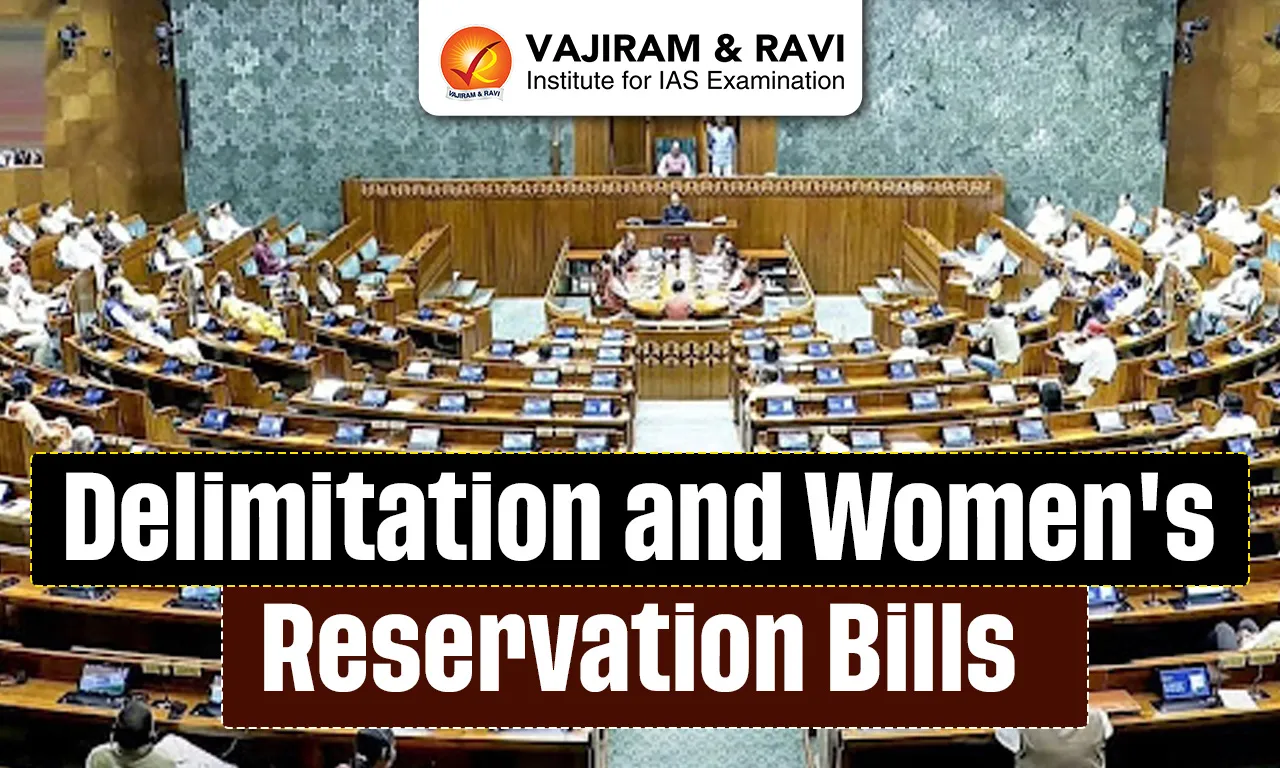
  • The Union government has introduced three key Bills, including the Constitution (131st Amendment) Bill, 2026, to operationalise 33% reservation for women in the Lok Sabha and State Assemblies. 
  • These Bills also propose a major overhaul of the delimitation process, which has remained frozen since the 1970s.

The Legislative Package

  • The Constitution (131st Amendment) Bill, 2026 — proposes expansion of Lok Sabha and amends Articles 81 and 82.
  • The Delimitation Bill, 2026 — establishes a new Delimitation Commission framework.
  • A third Bill facilitating women's reservation in State Assemblies and Union Territory (UT) legislatures.

Key Provisions

  • Expanding the Lok Sabha:
    • From the current strength from the current 543 seats to up to 850, by revising the cap to 815 MPs from States and 35 from UTs. 
    • This represents a 50% increase over existing strength — and aligns with the seating capacity of 888 members in the new Parliament building (expandable to 1,272 for joint sittings). Larger membership would technically mean smaller constituency sizes geographically.
  • Women's reservation (The 2029 target):
    • Although the Constitution (106th Amendment) Act, 2023 had already legislated 33% reservation for women, its implementation was tied to a post-Census delimitation.
    • Since the 2021 Census remains ongoing with no clear completion timeline, the government now proposes conducting delimitation on the basis of the 2011 Census (the "latest Census").
    • Hence, the central government is targeting implementation from the 2029 Lok Sabha elections onwards.
  • Redefining "Population" under Article 81:
    • Shifting from "the last preceding Census" to "population as ascertained at such Census as Parliament may by law determine". 
    • This grants Parliament the discretion to choose which Census data underpins any given delimitation exercise, introducing political flexibility into a previously constitutional-mechanical process.

The North-South Divide - A Political Fault Line

  • Delimitation - a politically sensitive issue:
    • Southern states — TN, Kerala, Karnataka, Andhra Pradesh, Telangana — achieved lower population growth rates by successfully implementing family planning policies. 
    • A straight population-based delimitation would therefore reduce their share of Lok Sabha seats relative to high-growth northern states.
    • This concern led Parliament to freeze delimitation twice (in 1976 and 2001) — postponing seat readjustment until after the first Census post-2026. 
  • New mechanism:
    • The new Bills propose removing this time-linked freeze, replacing it with a Parliament-triggered process.
    • However, the constitutional principle (Article 81) that the population-to-seat ratio must be "as far as practicable, the same for all States" — directly conflicts with the commitment to preserve current regional seat proportions. 
    • Reconciling these two positions is expected to be the sharpest point of parliamentary debate.

Structural Shift in Delimitation

  • Renaming Article 82: From "Readjustment after each Census" to "Readjustment of constituencies", simultaneously removing the mandatory link between delimitation and decadal Census cycles.
  • From two-thirds to simple majority:
    • Historically, any deferral of delimitation required a two-thirds constitutional majority — precisely to prevent political manipulation of electoral boundaries. 
    • The proposed framework lowers this threshold to a simple parliamentary majority, potentially giving future ruling coalitions greater leverage to time delimitation exercises to political advantage.
  • Delimitation Commission: 
    • The Delimitation Bill, 2026 provides for a Commission that will work on the basis of the "latest Census figures" and established criteria such as administrative boundaries, physical features, and public convenience. 
    • However, no allocation formula is specified for distributing seats across states, leaving a visible gap between political assurance and legal architecture.

Challenges

  • Constitutional tension: The "one person, one vote, one value" principle under Article 81 is difficult to reconcile with the promise of maintaining existing seat proportions for southern states.
  • Lowered constitutional safeguards: Moving delimitation from a constitutionally-triggered to a legislatively-triggered process reduces institutional protection against political misuse.
  • Census delay: The ongoing 2021 Census has already derailed one implementation cycle; relying on the 2011 Census is a workaround, not a structural fix.
  • Women's reservation timeline: The 2029 target remains contingent on the delimitation process running smoothly and on time.

Way Forward

  • Parliament must debate and define a clear seat-allocation formula that satisfies both the constitutional requirement of equitable representation and the political commitment to regional fairness.
  • A transparent and independent Delimitation Commission with defined terms of reference — rather than broad legislative discretion — would strengthen public trust in the process.
  • Restoring some form of constitutional safeguard around the frequency and triggers of delimitation would prevent future politicisation of constituency boundaries.
  • The 2021 Census must be expedited, as continued delays will perpetuate uncertainty around future delimitations and reservation implementation.

Conclusion

  • The proposed Bills mark a transformative moment in India’s electoral and constitutional framework. 
  • While the intent to fast-track representation reform is evident, the shift from a rule-based to discretion-based system raises critical concerns about federal balance, electoral fairness, and constitutional integrity. 
  • The success of these reforms will depend on transparency, institutional safeguards, and political consensus, ensuring that the democratic promise of inclusive and equitable representation is truly realised.

Source: IE | IE

Delimitation and Women's Reservation Bills FAQs

Q1: What is the significance of the Constitution (131st Amendment) Bill, 2026?

Ans: It enhances representational capacity through smaller constituencies but raises concerns over equitable inter-state seat distribution.

Q2: How the proposed changes to Article 82 alter the nature of delimitation in India?

Ans: It transforms delimitation from a mandatory decadal constitutional exercise into a discretionary process controlled by Parliament.

Q3: What are the challenges in implementing women’s reservation in legislatures?

Ans: Delays due to delimitation dependency, lack of clarity on seat allocation, and political consensus remain key hurdles.

Q4: How does the delimitation debate reflect tensions between federalism and electoral equality?

Ans: Population-based seat allocation may uphold vote equality but risks undermining federal balance by disadvantaging southern states.

Q5: What are the implications of redefining ‘population’ under Article 81?

Ans: It introduces flexibility in seat allocation but increases the scope for political discretion and potential misuse.

CAPF Bill 2026 – Codifying IPS Deputation

CAPF Bill 2026

CAPF Bill Latest News

  • The Union government has proposed the Central Armed Police Forces (General Administration) Bill, 2026, to codify IPS deputation and address recent Supreme Court directions. 

Central Armed Police Forces and IPS Deputation

  • The Central Armed Police Forces (CAPFs) are key pillars of India’s internal security architecture. 
  • They include forces such as CRPF, BSF, ITBP, CISF, and SSB, which perform functions like border guarding, counter-insurgency, and maintaining internal security.
  • Historically, leadership positions in CAPFs have been shared between:
    • Cadre officers (direct recruits within CAPFs)
    • Indian Police Service (IPS) officers on deputation
  • IPS officers, being part of an All India Service under Article 312, have traditionally occupied senior leadership roles in CAPFs to ensure coordination between the Centre and States.

Existing System of Deputation

  • Before the proposed Bill, IPS deputation in CAPFs was governed by executive orders.
    • Around 20% of posts at the DIG level are reserved for IPS officers
    • Around 50% of posts at the IG level are filled through IPS deputation 
  • There was no comprehensive statutory framework governing these appointments, leading to ambiguity and litigation.

Structural Issues in CAPFs

  • The controversy also highlights deeper structural challenges:
    • Around 10 lakh personnel in CAPFs
    • Only about 13,000 Group A officers
    • Nearly 93,000 vacancies across ranks 
  • These issues point to systemic gaps in manpower planning, promotions, and cadre management.

Key Provisions of the CAPF Bill 2026

  • The proposed Bill seeks to formalise and expand IPS deputation in CAPFs.
    • 50% of Inspector General (IG) posts to be filled by IPS officers
    • At least 67% of Additional Director General (ADG) posts to be held by IPS officers
    • All posts of Special DG and DG to be reserved for IPS officers 
  • The Bill aims to create an umbrella legal framework to regulate recruitment and service conditions of Group A officers in CAPFs.

Rationale Behind the Bill

  • Administrative Clarity: The absence of a statutory law led to fragmented rules and multiple court cases. The Bill aims to bring uniformity.
  • Reducing Litigation: Frequent disputes between CAPF cadre officers and IPS officers have resulted in prolonged litigation. The Bill seeks to “avoid unnecessary litigation.” 
  • Strengthening Coordination: Since CAPFs operate closely with State police, IPS officers are considered essential for maintaining Centre-State coordination.
  • National Security Imperative: CAPFs perform critical roles such as Border security, Counter-insurgency operations and Internal security management.
  • The government argues that experienced IPS leadership enhances operational efficiency.

Supreme Court Judgment and Policy Response

  • The Bill comes in the backdrop of a May 2025 Supreme Court judgment, which directed progressive reduction of IPS deputation in CAPFs up to IG level.
  • Additionally:
    • CAPF officers were granted Organised Group A Services (OGAS) status
    • The Court called for a cadre review and new service rules
  • The government’s Bill is seen as a legislative response to balance judicial directions with administrative needs. 

Concerns Raised by CAPF Officers

  • The proposal has faced strong opposition from retired and serving CAPF officers.
  • Career Stagnation
    • Limited senior posts for cadre officers
    • First promotion often takes 15-18 years 
  • Perceived Discrimination
    • Cadre officers argue that reserving top posts for IPS officers undermines their career progression despite operational experience.
  • Ignoring Judicial Intent
    • Critics contend that the Bill contradicts the Supreme Court’s directive to reduce IPS deputation.

Significance of the Bill

  • Institutionalising Administrative Practices: The Bill converts executive practices into statutory provisions, reducing ambiguity.
  • Federal Balance: By emphasising IPS deputation, it reinforces Centre-State administrative linkages.
  • Civil Services Reform Debate: The issue has reopened debates on:
    • Role of All India Services
    • Autonomy of specialised forces
    • Career progression within uniformed services

Source: TH | TOI

CAPF Bill FAQs

Q1: What is the CAPF Bill 2026?

Ans: It is a proposed law to regulate recruitment and service conditions in CAPFs and codify IPS deputation.

Q2: Why is the Bill being introduced?

Ans: To provide legal clarity, reduce litigation, and formalise existing deputation practices.

Q3: What did the Supreme Court direct in 2025?

Ans: It asked for a gradual reduction of IPS deputation up to IG level in CAPFs.

Q4: Why are CAPF officers opposing the Bill?

Ans: Due to concerns over career stagnation and limited promotional opportunities.

Q5: What role do CAPFs play in India?

Ans: They handle border security, internal security, and counter-insurgency operations.

CAPF Bill Controversy: Key Issues in CAPF Bill and IPS Deputation Debate

CAPF Bill Controversy

CAPF Bill Controversy Latest News

  • The Central Armed Police Forces (General Administration) Bill, 2026, introduced in the Rajya Sabha, proposes reserving senior leadership positions in CAPFs largely for IPS officers on deputation. 
  • It mandates:
    • 50% of Inspector General (IG) posts 
    • At least 67% of Additional Director General (ADG) posts 
    • 100% of Special DG and DG posts 
      • to be filled by IPS officers.
  • The proposal has drawn criticism from the Opposition and retired CAPF officials, who argue it may limit career progression opportunities for cadre officers within CAPFs.

Background: Supreme Court Judgment and Government’s Response

  • The Bill was introduced following a Supreme Court judgment (May 2025) which directed that deputation of IPS officers to senior posts in CAPFs should be gradually reduced within two years. 
  • The Court also recognised CAPF Group A officers as Organised Group A Services (OGAS), similar to IAS, IPS, and IFS.

Government’s Response and Legal Developments

  • The Ministry of Home Affairs (MHA) filed a review petition against the judgment, but it was dismissed in October 2025. 
  • Despite this, the MHA continued appointing IPS officers to key positions in CAPFs, leading to allegations of non-compliance.
  • Retired CAPF officers filed a contempt petition against the Union Home Secretary for not implementing the Court’s order. 
  • In response, the government proposed a legal solution, leading to Cabinet approval of the CAPF (General Administration) Bill, 2026 to address the issue through legislation.

About CAPFs

  • The Central Armed Police Forces (CAPFs) include seven forces: 
    • Assam Rifles (guards Indo-Myanmar and counter insurgency operations in NE)
    • the BSF (guards Pakistan and Bangladesh borders), 
    • CISF (protects airports and critical infrastructure), 
    • CRPF (handles internal security and law and order), 
    • SSB (guards Nepal and Bhutan borders), and 
    • ITBP (secures the China border).
    • National Security Guard (an elite counter-terrorism unit)
  • Currently, IPS officers occupy key leadership roles in CAPFs, with 20% of Deputy Inspector General posts and 50% of Inspector General posts reserved for them through executive orders. 
  • The Ministry of Home Affairs (MHA) controls both CAPFs and IPS cadres.

Personnel and Recruitment

  • CAPFs have around 13,000 Group A officers and nearly 10 lakh personnel in total. 
  • Recruitment is conducted through the Union Public Service Commission (UPSC), ensuring a structured entry into these forces.

Current IPS Deployment

  • As of March 9, 2026, there are 213 sanctioned IPS posts in CAPFs, with 35 vacancies. 
  • Across India, there are about 4,594 IPS officers, with 40% of senior posts earmarked for Central deputation and 60% for state roles.

Why is there opposition to the Bill

  • Retired CAPF officials oppose the Bill, arguing it undermines the Supreme Court’s ruling. 
  • They highlight career stagnation, noting that CAPF officers face slow promotions compared to IPS officers, who advance much faster. 
  • They also object to reserving 100% of Special Director General posts for IPS officers, limiting career growth for CAPF personnel.

Government’s Justification

  • The government maintains that CAPFs handle critical national security functions requiring coordination with states. 
  • It argues that IPS officers are essential for effective functioning and for maintaining strong Centre–State relations.

Concerns Raised by Opposition Leaders

  • Opposition leaders have criticised the Bill as an overreach. 
  • They said it undermines judicial authority and pointed to low morale in CAPFs due to poor promotions. 
  • They argued Parliament cannot override court rulings without proper legal basis. 

Other Concerns

  • Lack of Domain Expertise - Critics argue that IPS officers deputed at senior levels often lack ground-level experience in CAPFs, affecting decision-making and operational effectiveness.
  • Need for Institutional Continuity - CAPFs handle complex roles like border security, counter-insurgency, and disaster response, which require long-term experience and continuity of leadership—something cadre officers are better positioned to provide.
  • Institutional Autonomy vs Bureaucratic Control - The Bill is seen as reinforcing bureaucratic control rather than promoting professional autonomy. Experts argue that modern security forces require specialised leadership, not external administrative dominance.
  • Equality and Fair Opportunity - Permanent exclusion of CAPF officers from top leadership raises concerns under Articles 14 and 16 (equality and equal opportunity).
  • National Security vs Service Interests - Critics argue the Bill prioritises IPS career progression over strengthening CAPFs. The focus on coordination and administrative control may not stand legal scrutiny, as courts have already examined these arguments.

Source: TH | TP

CAPF Bill Controversy FAQs

Q1: What is the CAPF Bill controversy about?

Ans: CAPF Bill controversy revolves around reserving senior CAPF posts for IPS officers, raising concerns about career stagnation, autonomy, and violation of Supreme Court directives.

Q2: What did the Supreme Court say about CAPFs?

Ans: CAPF Bill controversy stems from a 2025 Supreme Court ruling recognising CAPF officers as Organised Group A Services and directing gradual reduction of IPS deputation.

Q3: Why are CAPF officers opposing the Bill?

Ans: CAPF Bill controversy highlights concerns over limited promotions, lack of leadership opportunities, and perceived dominance of IPS officers in top positions within CAPFs.

Q4: What is the government’s justification for the Bill?

Ans: CAPF Bill controversy includes government arguments that IPS officers ensure coordination with states and strengthen national security administration across CAPFs.

Q5: What constitutional concerns are raised?

Ans: CAPF Bill controversy raises issues under Articles 14 and 16 regarding equality, fair opportunity, and whether Parliament can override judicial directions through legislation.

Enquire Now