Hussain Sagar Lake

Hussain Sagar Lake

Hussain Sagar Lake Latest News

Hussain Sagar lake is emitting a strong foul odour as rising summer temperatures trigger heavy algal bloom.

About Hussain Sagar Lake

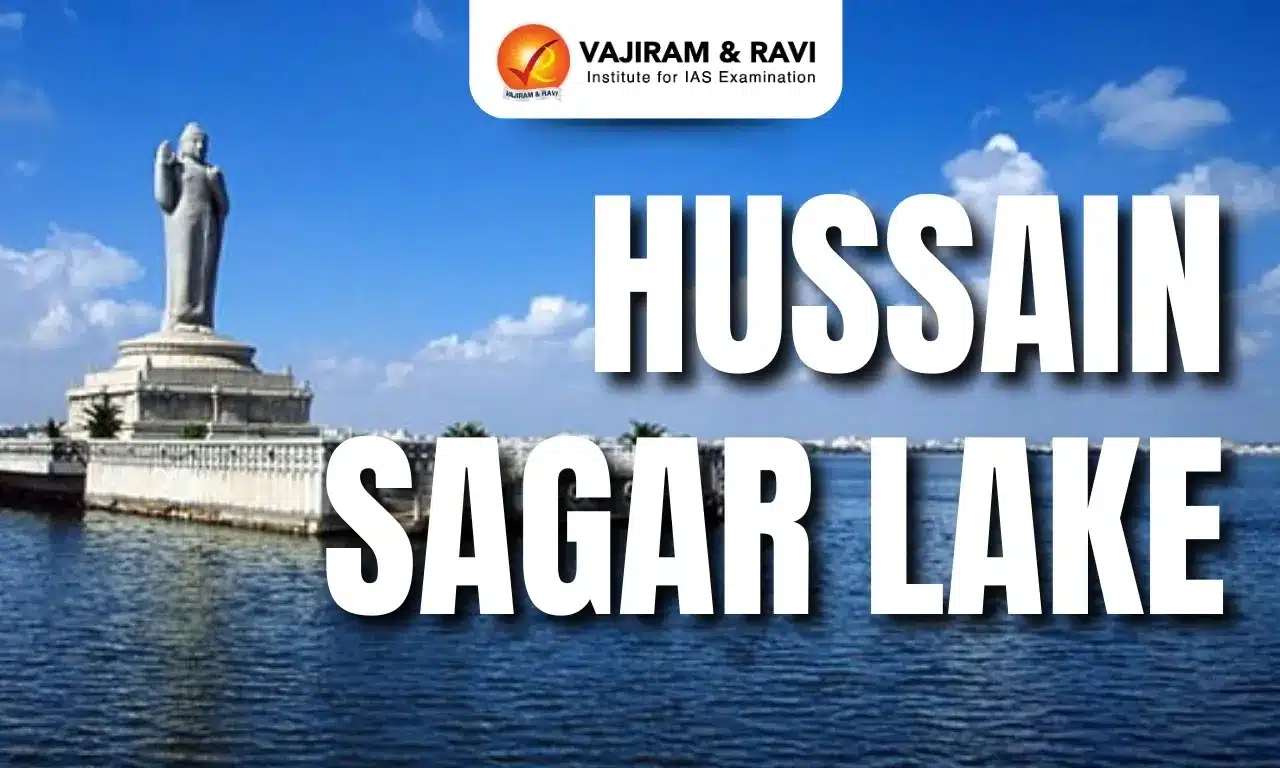
  • It is an artificial lake located in Hyderabad, Telangana.
  • It is also called Tank Bund and lies on a tributary of River Musi. 
  • It spreads across an area of 5.7 sq.km. It is one of the largest man-made lakes in Asia.
  • It is the largest heart-shaped mark among the marks formed by 78 heart-shaped lakes and 9 heart-shaped islands on the face of the earth.
  • The United Nations World Tourism Organisation has named the lake “Heart of the World”.
  • It was constructed in 1562 AD during the reign of Ibrahim Quli Qutb Shah, the fourth ruler of the Qutb Shahi dynasty. 
  • The lake was named after Hussain Shah Wali, the chief engineer who designed and supervised its construction.
  • It is renowned for its monolith of Lord Buddha that stands right in its centre. It has a height of 16 m and weighs almost 350 tonnes.
  • It had been of significance in the early days since it connected the twin cities of Hyderabad and Secunderabad.
  • It was initially built to cater to the irrigation needs and other water needs of the city. Until the year of 1930, it was used for the same purpose.
  • Indira Park, Lumbini Park, and Sanjeevaiah Park surround the lake on three sides.
  • Over the years, Hussain Sagar Lake has become polluted through the entry of untreated sewage and industrial effluents through the nalas that flow into the lake.

Source: TT

Hussain Sagar Lake FAQs

Q1: Where is Hussain Sagar Lake located?

Ans: It is an artificial lake located in Hyderabad, Telangana.

Q2: On which river system is Hussain Sagar Lake located?

Ans: It lies on a tributary of the Musi River.

Q3: Why is Hussain Sagar Lake unique in shape?

Ans: It is the largest heart-shaped mark among heart-shaped lakes and islands.

Q4: During whose reign was the lake built?

Ans: It was constructed in 1562 AD during the reign of Ibrahim Quli Qutb Shah, the fourth ruler of the Qutb Shahi dynasty.

Q5: After whom is Hussain Sagar Lake named?

Ans: The lake was named after Hussain Shah Wali, the chief engineer who designed and supervised its construction.

Astra Mark 2 Missile

Astra Mark 2 Missile

Astra Mk2 Missile Latest News

India is planning to equip Mirage 2000 jets with Astra Mk2 missiles, enabling long-range interception up to 240 km and strengthening aerial dominance.

About Astra Mk2 Missile

  • It is a Beyond Visual Range (BVR) air-to-air missile.
  • It is being developed by the Defence Research and Development Organisation (DRDO).
  • In addition to various laboratories of DRDO, more than 50 public and private industries, including Hindustan Aeronautics Limited, have contributed towards successful realisation of the weapon system. 
  • The Astra Mark-1 air-to-air missile with a strike range of around 90-100 kms is already in the Indian Air Force and is already integrated with the LCA Tejas and the Su-30 MKI fighter jets.
  • The Astra Mark 2 would give the Indian Air Force an edge over the adversaries in air-to-air combat and can also be offered as an export product to friendly foreign countries.

Astra Mk2 Missile Features

  • While the Astra Mark-1 is a single-pulse, smokeless solid-fueled motor, the Astra Mark-2 uses a dual-pulse solid rocket motor for extended reach and better kinematics during the kill phase. 
  • Astra Mk-1 is 3.6 m (12 ft) long with a diameter of 178 mm (7.0 in) and weighs 154 kg with a maximum range of 110 km. The Astra Mark 2 will be a bigger missile with a diameter of 190 mm and weigh close to 175 kg.
  • Range: 200–240 km (high altitude conditions)
  • Astra Mk-2 will use the indigenous seeker manufactured by Bharat Electronics Limited (BEL).
  • This seeker is equipped with electronic counter-countermeasures (ECCM), enhancing its ability to resist jamming and electronic warfare tactics.
  • Another critical feature is the two-way datalink that enables mid-course updates. This allows the missile to receive real-time guidance corrections from the launch platform or other assets.

Source: IMM

Astra Mk2 Missile FAQ's

Q1: What is the Astra Mk-2 Missile?

Ans: It is a Beyond Visual Range (BVR) air-to-air missile.

Q2: Which organization is developing the Astra Mk-2 missile?

Ans: It is being developed by the Defence Research and Development Organisation (DRDO).

Q3: What type of propulsion system does Astra Mk-2 use?

Ans: Dual-pulse solid rocket motor.

Q4: What is the approximate range of Astra Mk-2?

Ans: 200–240 km (at high altitude).

Austria

Austria

Austria Latest News

India and Austria recently signed multiple agreements and announcements aimed at deepening bilateral cooperation across defence, trade, technology, education, and culture.

About Austria

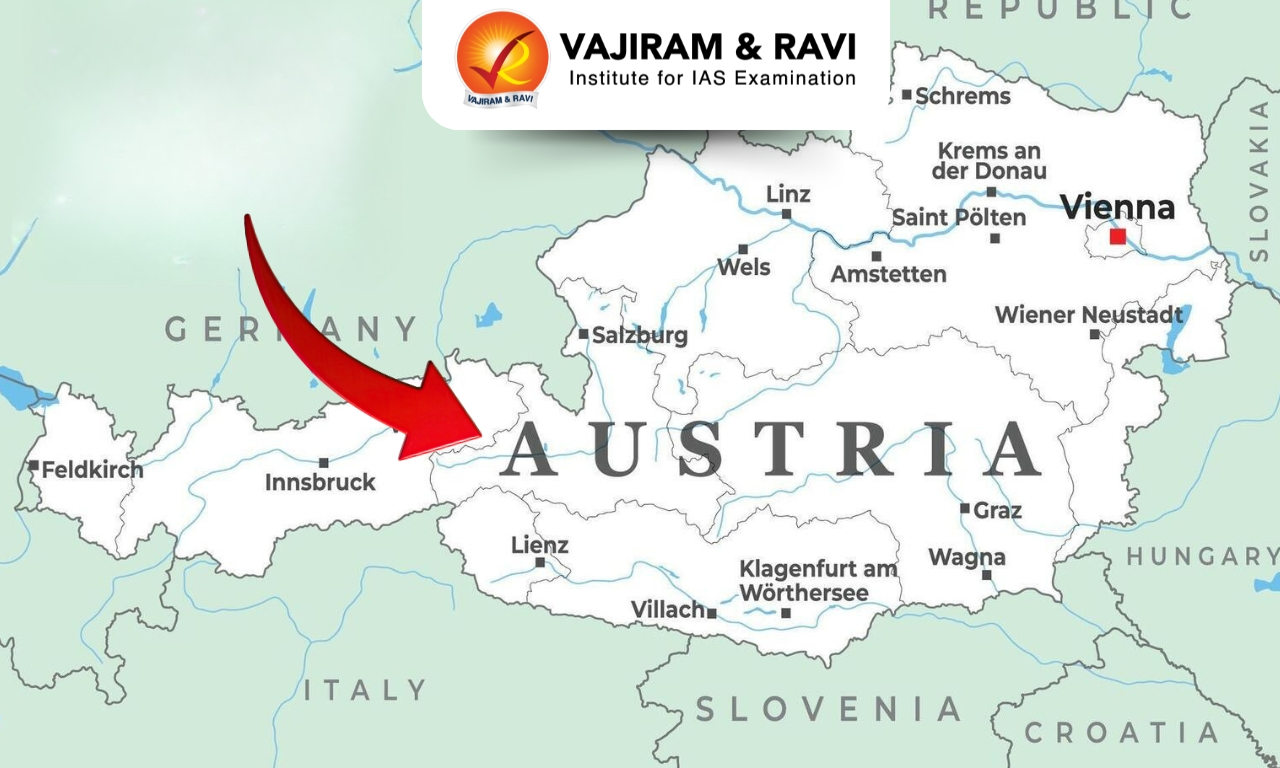
  • It is a largely mountainous landlocked country of south-central Europe. 
  • Capital: Vienna
  • Austria is bordered by 8 countries: by the Czech Republic in the north; by Slovakia in the northeast; by Hungary in the east; by Slovenia in the south; by Italy in the southwest; by Switzerland and Liechtenstein in the west; and by Germany in the northwest.
  • Most of Austria (70%) is covered by the Alpine Region, central and west, as the Alps extend on into Austria from Switzerland.
  • It has a temperate and alpine climate. 
  • The Danube (1,771 miles) (2,850 km) is the most significant river in the country. It's the second-longest river in Europe and a vital waterway for commerce. 
  • Ethnic groups: Germans, Turks, Serbs, Croats, Slovenes, and Bosnians; other recognized minorities include Hungarians, Czechs, Slovaks, and Roma.
  • Languages: The majority of the population speaks German, which is also the country's official language. Other local official languages are Croatian, Hungarian, and Slovene.
  • Political System: It is a federal parliamentary republic with a chancellor who is the head of government and a president who is the head of state.

Austria History

  • The origins of Austria date back to the time of the Roman Empire when a Celtic kingdom was conquered by the Romans in approximately 15 BC and later became Noricum, a Roman province, in the mid-1st century ADan area which mostly encloses today's Austria. 
  • In 788 AD, the Frankish king Charlemagne conquered the area and introduced Christianity. 
  • Under the native Habsburg dynasty, Austria became one of the great powers of Europe. 
  • During the 18th and 19th centuries, Vienna was the European capital of classical music and an important hub of musical innovation.  
  • Legendary musicians like Mozart, Beethoven, Joseph Haydn, Johann Strauss II, and others are all associated with Vienna.
  • In 1867, the Austrian Empire was reformed into Austria-Hungary.
  • The Austro-Hungarian Empire collapsed in 1918 with the end of World War I.
  • The First Austrian Republic was established in 1919.

Source: DDN

Austria FAQs

Q1: What is the capital of Austria?

Ans: Vienna

Q2: Which major mountain range covers most of Austria?

Ans: The Alps

Q3: What is the most significant river in Austria?

Ans: The Danube River

Q4: What is the political system of Austria?

Ans: A federal parliamentary republic.

Tharu Tribe

The Delimitation Controversy

Tharu Tribe Latest News

The Lucknow bench of the Allahabad High Court recently set aside a district-level committee’s decision to reject the community forest rights claims of the Tharu tribe in Lakhimpur Kheri.

About Tharu Tribe

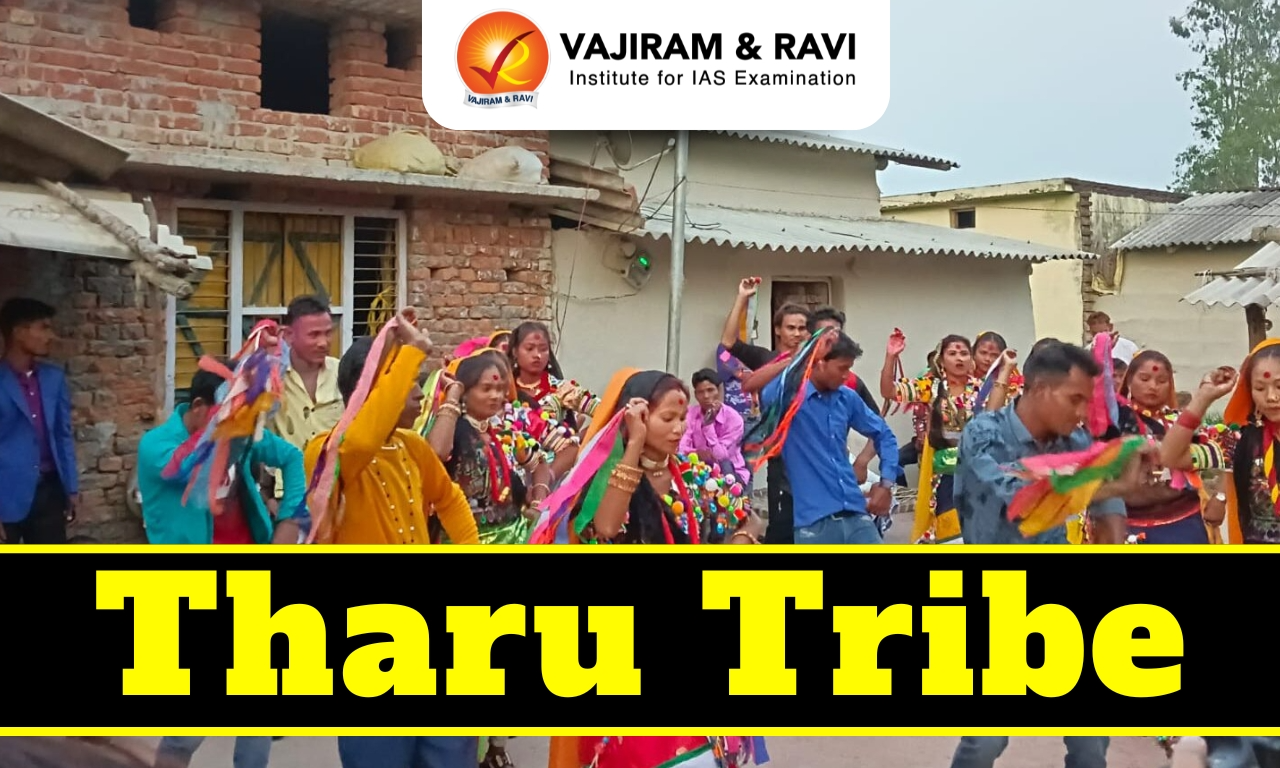
  • The Tharu tribe is one of the indigenous groups living in the Terai plain on the Indo-Nepal border. 
  • The Tharu are the largest and oldest ethnic group of the Terai region.
  • They live in both India and Nepal.
  • In the Indian Terai, they live mostly in Uttarakhand, Uttar Pradesh, and Bihar. 
  • In 1967, this tribe was documented as a Scheduled Tribe by the Government of India. 
  • Language: They have their own language called Tharu or Tharuhati, a language of the Indo-Aryan subgroup of the Indo-Iranian group of the Indo-European family.
  • Economy: Most Tharu practice agriculture, raise cattle, hunt, fish, and collect forest products. 
  • Most of their food involves rice, lentils, and vegetables. 
  • Tharu traditional homes, known as “Badaghar,” are made with local materials such as mud, wood, and thatch.
  • Society:
    • Despite their patrilineal social system, women have property rights greatly exceeding those recognized in Hindu society.
    • Tharu marriages are patrilocal within the tribe.
    • A common feature of the Tharu community is the joint family system of living in long houses.
    • Tharus live in compact villages, usually in the middle of a forest clearing. 
    • The Panchayat system (Local Social Council) is very strong in this tribe; the head of the panchayat is called ‘’Pradhan’’ in the local Tharu language.
  • Religion: The Tharu people practice a unique blend of animism, Hinduism, and nature worship.

Source: LAWT

Tharu Tribe FAQs

Q1: Who are the Tharu Tribe?

Ans: They are an indigenous group living in the Terai plains along the Indo-Nepal border.

Q2: In which Indian states are Tharu mainly found?

Ans: Uttarakhand, Uttar Pradesh, and Bihar.

Q3: What are traditional Tharu houses called?

Ans: “Badaghar”.

Q4: How are Tharu villages typically structured?

Ans: Compact villages located in forest clearings.

Borrowers’ Platform

Borrowers’ Platform

Borrowers’ Platform Latest News

Recently, developing countries have launched the first-ever Borrowers’ Platform at the International Monetary Fund (IMF)-World Bank Spring Meetings 2026.

About Borrowers’ Platform

  • It is a dedicated space enabling developing countries that are borrowers to come together, share knowledge, exchange experiences and speak collectively on debt issues.
  • It brings together finance ministers and central bank governors from developing countries to strengthen debt management capacity, enhance coordination and amplify their collective voice in global debt discussions.
  • It will be governed by the ministers of finance of participating countries. They will be supported by technical officials responsible for debt.
    • It is not a forum for collective debt-restructuring negotiations.
  • Members: It has 30 members including India. Its working group is chaired by Egypt.
  • Secretariat: It is supported by the United Nations Conference on Trade and Development as its secretariat.
  • Significance: As developing countries’ external debt burden reached $11.7 trillion in 2024. So it will help in addressing the debt burden.

Source: DTE

Borrowers’ Platform FAQs

Q1: Which UN body serves as the secretariat for the Borrowers’ Platform?

Ans: UNCTAD – UN Trade and Development

Q2: What is the main purpose of the Borrowers’ Platform?

Ans: To give debt-hit nations a stronger collective voice in dealings with creditors

River Basin Management Scheme

River Basin Management Scheme

River Basin Management Scheme Latest News

The River Basin Management (RBM) Scheme has led to measurable improvements in water resource planning and infrastructure development across key river basins. 

About River Basin Management Scheme

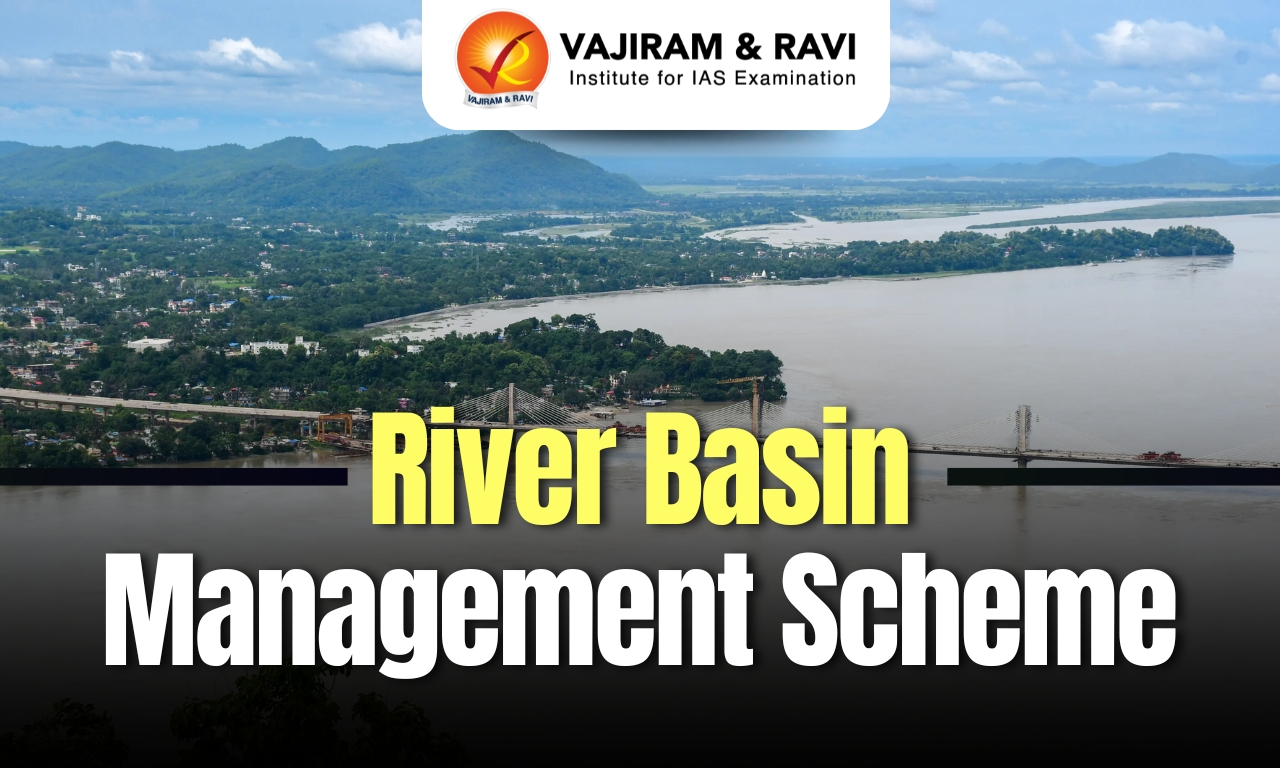
  • It is a central sector scheme of the Department of Water Resources, River Development, and Ganga Rejuvenation under the Ministry of Jal Shakti.
  • It aims to facilitate integrated planning, investigation, and development of water resources at the river basin level, including both surface water and groundwater systems.
  • It is implemented through three key organisations namely, 
  • It supports activities such as the preparation of basin master plans, the survey and investigation of projects, and the planning of multipurpose projects.
  • It is a comprehensive scheme for the management, protection, improvement, and sustainable use of water resources across river basins.
  • These resources include rivers, lakes, streams, groundwater, and associated ecosystems.
  • Financial Outlay and Duration: It is proposed to be continued during the 16th Finance Commission period from 2026–27 to 2030–31 with a fully funded estimated financial outlay of ₹2183 crore.
  • Objectives of River Basin Management Scheme
    • Ensure protection, improvement, and sustainable use of water resources across river basins.
    • Promote development of surface water and groundwater resources.
    • ​Undertake survey, investigation, and preparation of basin master plans.
    • Facilitate planning of irrigation, hydropower, and multipurpose projects.
    • ​Support integrated development of water resources for multiple uses, including navigation and ecological conservation

Source: PIB

River Basin Management Scheme FAQs

Q1: Which ministry handles River Basin Management Plans?

Ans: Ministry of Jal Shakti

Q2: What is the main aim of River Basin Management Plans in India?

Ans: Integrated cleaning, conservation and management of rivers on basin-wide approach

Chenchu Tribe

Chenchu Tribe

Chenchu Tribe Latest News

Recently, Chenchu tribals in Amrabad Tiger Reserve opposed relocation from forest areas, citing livelihood concerns. 

About Chenchu Tribe

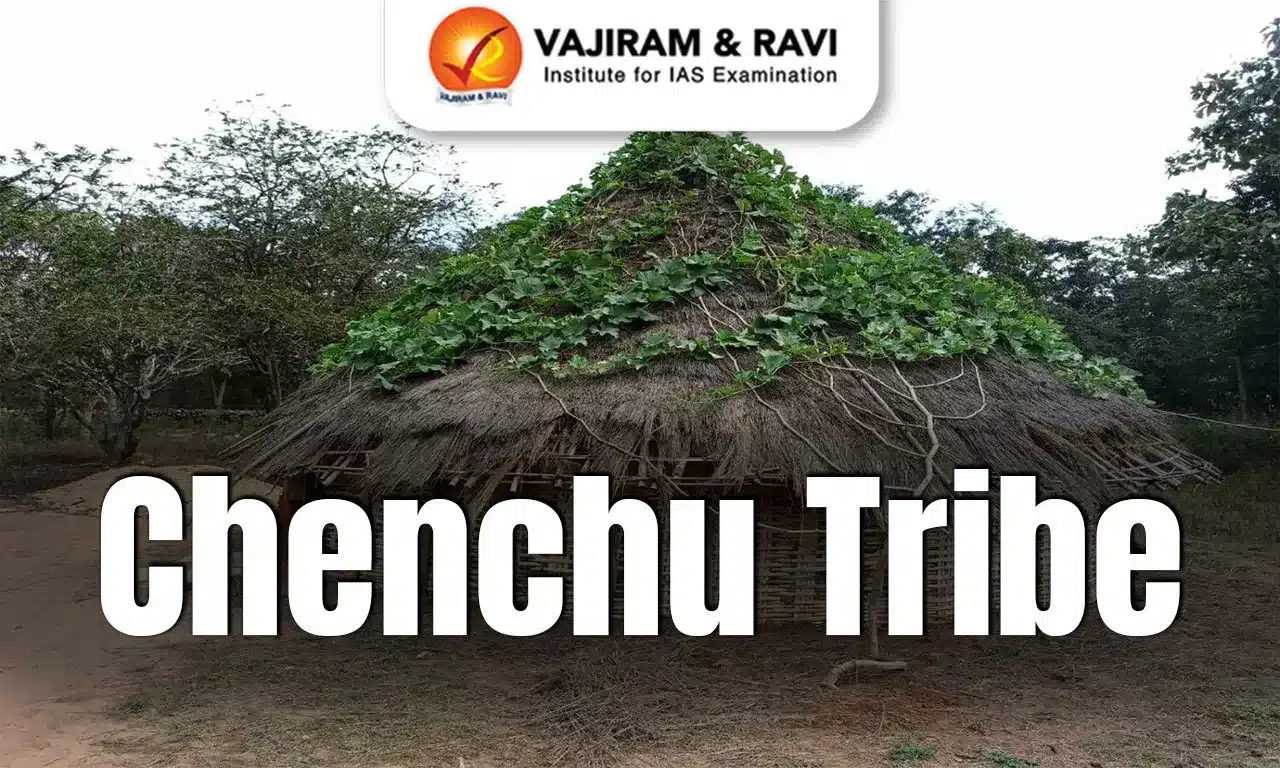
  • The Chenchus primarily reside in the Nallamalai forests of Andhra Pradesh.
  • They are one of the Particularly Vulnerable Tribal Groups (PVTGs) in Andhra Pradesh.
  • They are also found in Telangana, Karnataka, and Odisha.
  • The Chenchus have been classified as the Proto Australoid group.
  • Language: They speak variants of Telugu, the Dravidian language of the region.
  • Society 
    • A Chenchu village is known as “Penta“. 
    • Each penta consists of a few huts that are spaced apart and are grouped together based on kinship patterns. 
    • Small conjugal families predominate, women taking equal rank with men and marrying only upon maturity.
    • “Peddamanishi” or the village elder, is generally the authority to maintain social harmony in a family or a village. 
  • Livelihood
    • The Chenchu live life with exemplary simplicity.  Most of them still gather food from the forest and roam in it to find things to meet their needs.
    • The Chenchus collect forest products like roots, fruits, tubers, beedi leaf, mohua flower, honey, gum, tamarind, and green leaves and make a meagre income from it by selling these to traders and government cooperatives.
  • Religion and Belief
    • Chenchus worship a number of deities. Chenchus have also adopted certain religious practices from Hindus.
    • They mainly believe in Bhagaban Taru who resides in the sky and Garelamai Sama, who is the Goddess of forest.
    • For ages, the Chenchus have been associated with the famous Srisailam temple (dedicated to Lord Shiva and Devi Brahmaramba) in Andhra Pradesh, situated at the heart of Chenchu land.

Source: TT

Chenchu Tribe FAQs

Q1: Chenchu tribe is mainly spread across which Indian states?

Ans: Andhra Pradesh, Telangana, Karnataka & Odisha

Q2: What category status is given to Chenchus by Govt of India?

Ans: Particularly Vulnerable Tribal Group (PVTG)

Zambia

Zambia

Zambia Latest News

Recently, India's talks with Zambia over critical minerals mining have stalled amid a lack of assurances from Lusaka on ​mining rights. 

About Zambia

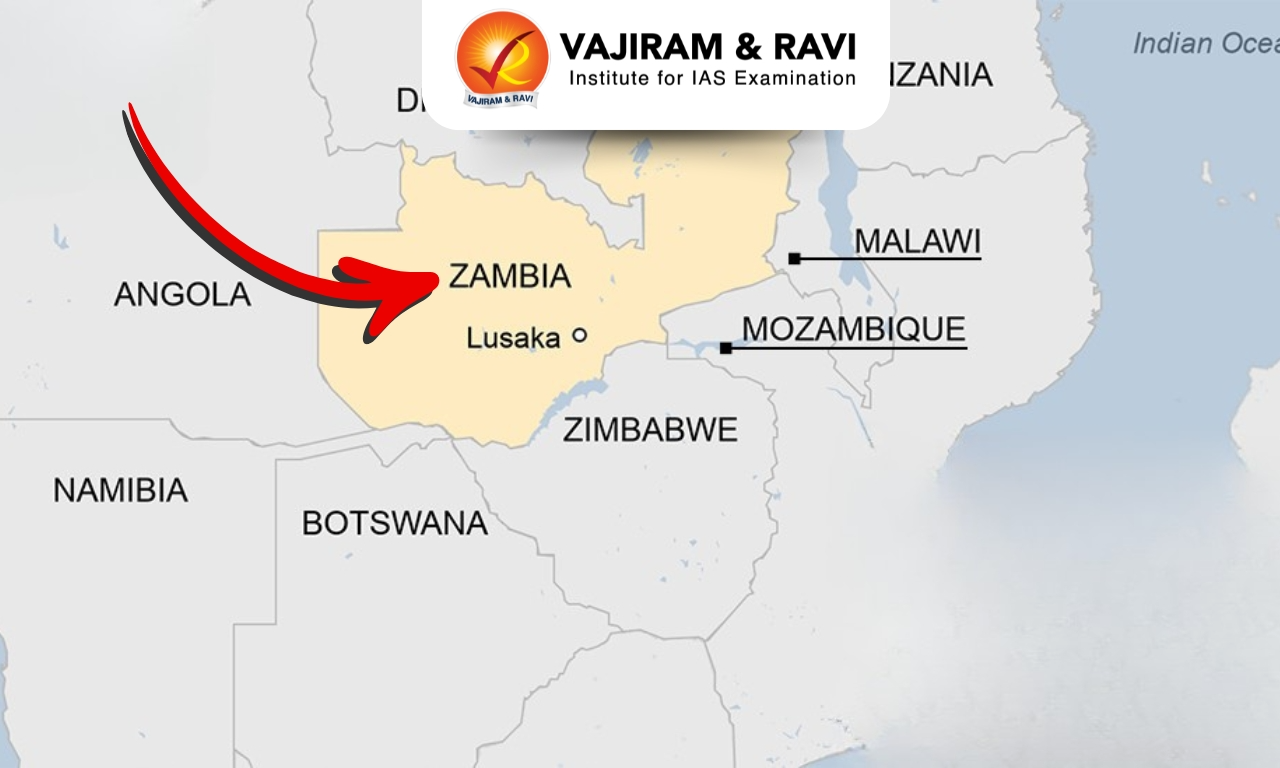
  • It is a Southern-Central African landlocked country.
  • Bordering Countries: It is bounded by the Democratic Republic of the Congo (North), Zimbabwe and Botswana (South), Tanzania (North-east), Malawi ( West) and Mozambique (Southeast), Angola and Zambia (West) and Namibia to the southwest.
  • Capital City: Lusaka

Geographical Features of Zambia

  • Climate: It has a sub-tropical climate that is tempered by its relatively high altitude, making it more temperate and pleasant than other sub-tropical areas.
  • Rivers: The most significant river is the Zambezi River (which empties into the Indian Ocean). Other major rivers include the Kafue and the Luangwa.
  • Mountain Range: Mafinga Mountains.
  • Lakes: Lake Tanganyika and Lake Kariba
  • Natural Resources: It has a wide range of natural resources including copper, cobalt, silver, uranium, lead, coal, zinc, gold, and emerald.

Source: Reuters

Zambia FAQs

Q1: What is the capital of Zambia?

Ans: Lusaka

Q2: Zambia is a landlocked country located in which continent?

Ans: Africa

Petroleum and Natural Gas Regulatory Board (PNGRB)

Petroleum and Natural Gas Regulatory Board

Petroleum and Natural Gas Regulatory Board (PNGRB) Latest News

The Petroleum and Natural Gas Regulatory Board (PNGRB) recently initiated the bidding process for the development of Liquefied Petroleum Gas (LPG) pipeline infrastructure to eliminate bulk movement to the extent possible.

About Petroleum and Natural Gas Regulatory Board (PNGRB)

  • It is a statutory body established under the Petroleum and Natural Gas Regulatory Board Act 2006.
  • Objective: To protect the interests of consumers and entities engaged in specified activities relating to petroleum, petroleum products, and natural gas and to promote competitive markets and for matters connected therewith or incidental thereto.
  • It has also been mandated to regulate the refining, processing, storage, transportation, distribution, marketing, and sale of petroleum, petroleum products, and natural gas, excluding the production of crude oil and natural gas, so as to ensure an uninterrupted and adequate supply of petroleum, petroleum products, and natural gas in all parts of the country.
  • PNGRB authorises the city gas distribution (CGD) networks, natural gas and petroleum product pipelines, determines tariffs, lays down the technical and safety standards, etc.
  • Entities required to comply with PNGRB regulations include:
    • Natural Gas Pipelines & Petroleum Product Pipelines.
    • City Gas Distribution (CGD) networks.
    • Liquefied Natural Gas (LNG) storage, transportation, and regasification.
    • Petroleum and gas marketing.
    • Refineries and storage terminals.
  • Nodal Ministry: Ministry of Petroleum and Natural Gas.
  • The Board has its seat in Delhi.
  • The board consists of the following members appointed by the Central Government:
    • Chairperson
    • Member (Legal)
    • Three other members
  • Power of the Board: Under Section 12 of the Act, certain powers are given to the PNGRB to deal with the complaints and resolve disputes among the entities. The powers under the Act are:
    • The Board is empowered to adjudicate and decide any dispute or matter among the entities.
    • The Board, on receiving any complaint from any person, is empowered to conduct an inquiry and investigation.
    • The Board can pass any order or issue any direction or refer the matter for investigation as it thinks fit.
    • The Board has similar powers as given to the Civil Court under the Civil Procedure Code, 1908.
    • The Board is subjected to the principles of natural justice and the provisions of the Act.

Source: NIE

Petroleum and Natural Gas Regulatory Board (PNGRB) FAQs

Q1: What is the Petroleum and Natural Gas Regulatory Board (PNGRB)?

Ans: It is a statutory body regulating petroleum and natural gas activities in India.

Q2: What is the main objective of Petroleum and Natural Gas Regulatory Board (PNGRB)?

Ans: To protect consumer interests and promote competitive markets in petroleum and natural gas sectors.

Q3: Does Petroleum and Natural Gas Regulatory Board (PNGRB) regulate the production of crude oil and natural gas?

Ans: No, it does not regulate production of crude oil and natural gas.

Q4: Which activities are regulated by Petroleum and Natural Gas Regulatory Board (PNGRB)?

Ans: Refining, processing, storage, transportation, distribution, marketing, and sale of petroleum and natural gas.

World Anti-Doping Agency

World Anti-Doping Agency

World Anti-Doping Agency Latest News

Recently, the Union Minister of Youth Affairs and Sports addressed the inaugural ceremony of the Final Conference of the World Anti-Doping Agency’s (WADA) Global Anti-Doping Intelligence & Investigations Network (GAIIN).

About World Anti-Doping Agency

  • It was established on 10 November 1999.
  • Its mission is to promote and coordinate the fight against doping in sport internationally.
  • Role: To develop, harmonize and coordinate anti-doping rules and policies across all sports and countries.
  • Its activities include scientific and social science research; education; intelligence & investigations; development of anti-doping capacity; and monitoring of compliance with the World Anti-Doping Program.
  • Headquarter: Montreal, Canada.

Governance of World Anti-Doping Agency

  • Foundation Board (Board)
    • It consists of 42-member and it is the agency’s highest policy-making body.
    • It is jointly composed of representatives of the Olympic Movement (the IOC, National Olympic Committees, International Sports Federations, and athletes) and representatives of governments from all five continents.
  • Executive Committee (ExCo)
    • It consists of 16-member to which the Board delegates the management and running of the agency, including the performance of all its activities and the administration of its assets.

Source: PIB

World Anti-Doping Agency FAQs

Q1: Where is the headquarters of WADA located?

Ans: Montreal, Canada

Q2: In which year was WADA established?

Ans: 1999

Enquire Now