
New Species of Fireflies

New Species of Fireflies

Fireflies Latest News

Scientists recently discovered two previously unknown species of fireflies named Diaphanes meghalayanus and Diaphanes mawlynnong in Meghalaya’s East Khasi Hills, marking the first formal documentation of such insects from the state.

About Diaphanes meghalayanus and Diaphanes mawlynnong

  • They are two new species of fireflies.
  • They were discovered in Meghalaya’s East Khasi Hills
  • D. meghalayanus has been named after Meghalaya to indicate its broader distribution in the region, while D. mawlynnong derives its name from Mawlynnong village, where the species was first recorded, acknowledging the local Khasi community. 
  • Both species thrive in dark, humid environments with minimal human interference. 
  • D meghalayanus was found in semi-evergreen forests as well as dense betel nut plantations interspersed with bamboo patches, typically during February. 
    • The species thrives in cool, humid conditions—around 18–20°C with 77–80% humidity—and flies at heights of 10–15 metres, glowing softly in the dark. 
  • D. mawlynnong appears to be more habitat-specific, inhabiting dense forests with thick bamboo growth and rocky streams.  
    • Males were observed flying about 15 metres above the ground, while the wingless female was found beneath a boulder—an unusual behaviour that offers rare insight into the species’ life cycle. 
    • Females emit a slower, longer pulsating glow compared to males.

Source: IT

New Species of Fireflies FAQs

Q1: What are Diaphanes meghalayanus and Diaphanes mawlynnong?

Ans: They are two newly discovered species of fireflies.

Q2: Where were Diaphanes meghalayanus and Diaphanes mawlynnong discovered?

Ans: They were discovered in the East Khasi Hills of Meghalaya.

Q3: What type of environment do these fireflies prefer?

Ans: They thrive in dark, humid environments with minimal human interference.

Exercise Pragati

Exercise Pragati

Exercise Pragati Latest News

The Indian Army is set to host military delegations to the inaugural edition of the multilateral exercise ‘Pragati’ at the Foreign Training Node in Umroi, Meghalaya.

About Exercise Pragati

  • The PRAGATI (Partnership of Regional Armies for Growth and Transformation in the Indian Ocean Region) is a multilateral military exercise.
  • It is the first edition of the exercise which will be held in Umroi, Meghalaya.
  • Participating Countries: It includes 11 friendly countries Laos, Myanmar, Seychelles, Sri Lanka, Philippines, Nepal, Maldives, Malaysia, Vietnam, Cambodia and Bhutan.
  • Aim: It aims to strengthen defence cooperation, enhance interoperability, and build mutual trust among participating nations.
  • It reflects a shared commitment to collective security and regional stability.
  • Key Focus of Exercise Pragati
    • It centers on counter-insurgency and counter-terrorism operations, emphasising joint training and defence diplomacy.
    • It is part of India’s growing defence engagement with its neighbouring and Indian Ocean region nations, focusing on building capacity and shared operational capabilities.
    • It will mark a shift in the Indian Army training from bilateral to consortium-style engagements.
    • Besides war games, a key component of the event is a two-day industry exposition, highlighting the Indian Army's capabilities and fostering industrial partnerships with ASEAN nations.

Source: DD News

Exercise Pragati FAQ's

Q1: Exercise PRAGATI 2026 is being held at which place?

Ans: Umroi, Meghalaya

Q2: What does PRAGATI as a military exercise stands for?

Ans: Partnership of Regional Armies for Growth and Transformation in the Indian Ocean Region

Kyrgyzstan

Kyrgyzstan

Kyrgyzstan Latest News

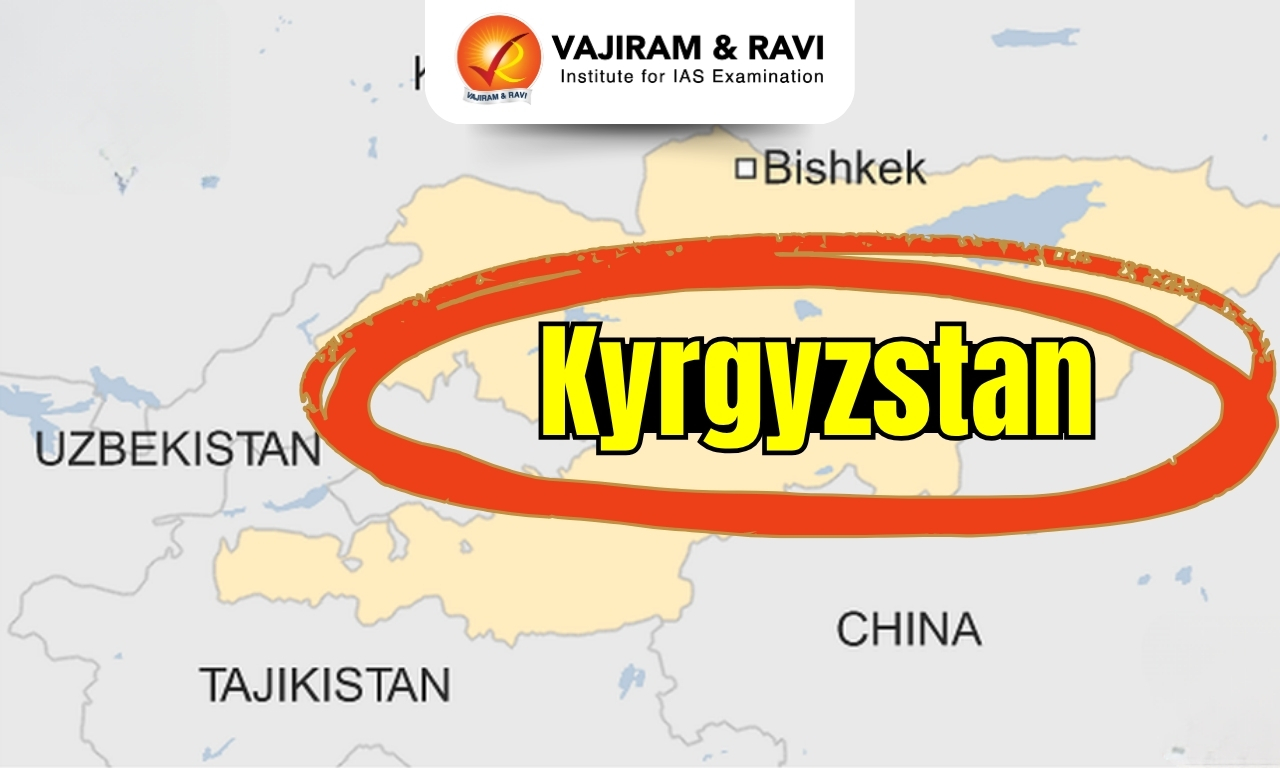
Recently, the Minister of Defence addressed the SCO Defence Ministers’ Meeting in Bishkek, Kyrgyzstan.

About Kyrgyzstan

  • Location:  It is a landlocked mountainous country in Central Asia.
  • Bordering Countries: It is bordered by four nations; Kazakhstan (north), Uzbekistan (west), Tajikistan (south), and China (east).
  • It is occasionally referred to as “the Switzerland of Central Asia”.
  • Capital City: Bishkek

Geographical Features of Kyrgyzstan

  • Climate: The climate is continental and varies according to the altitude. The winters are cold, often freezing, and the summers warm and sunny.
  • Highest Peak: The highest point in Kyrgyzstan Victory Peak, standing at an elevation of 7,439 meters
  • Major Rivers: Syr Darya, Naryn, Chu.
  • Lakes: Lake Issyk-Kul, the second-largest saline lake in the world is located here.
  • Natural Resources: It consists of coal, oil, natural gas, and uranium, alongside deposits of gold and rare earth metals.

Source: HT

Kyrgyzstan FAQs

Q1: Which major mountain range dominates the geography of Kyrgyzstan?

Ans: Tian Shan

Q2: What is the capital city of Kyrgyzstan?

Ans: Bishkek

E-PRAAPTI Portal

E-PRAAPTI Portal

E-PRAAPTI Portal Latest News

The Employees Provident Fund Organisation (EPFO) is set to launch E-PRAAPTI (EPF Aadhaar-Based Access Portal for Tracking Inoperative Accounts).

About E-PRAAPTI Portal

  • E-PRAAPTI (EPF Aadhaar-Based Access Portal for Tracking Inoperative Accounts), a dedicated digital platform of the Employees Provident Fund Organisation (EPFO).
  • Purpose: To facilitate identification, tracking, Unique Account Number (UAN) linking, and activation of old EPF accounts. 
  • It must be noted that a PF account becomes inactive when no new contributions are made to the account for 36 consecutive months after leaving the job, or the PF record of the old company is not linked to the active UAN (Universal Account Number). 
    • EPFO began issuing a 12-digit unique number, UAN, to each employee in 2014.  
  • The E-PRAAPTI Portal will provide a streamlined Aadhaar-based authentication mechanism that will enable members to securely access their old EPF account that are not linked to a UAN and initiate the process for updating their member profile, followed by seamless UAN linking and activation. 
  • In the initial phase, the portal will be member ID-based, ensuring a secure and efficient rollout while delivering immediate benefits to a large segment of members who possess their member IDs.
  • E-PRAAPTI’s scope will later be expanded to include members who may not be able to recall or access their old member IDs. 

Source: TH

Piprahwa Relics

Piprahwa Relics

Piprahwa Relics Latest News

Leh witnessed a rare confluence of faith and history recently as the sacred Piprahwa relics of Gautam Buddha were ceremoniously brought to the high-altitude town, ushering in a landmark spiritual celebration across Ladakh.

About Piprahwa Relics

  • The Piprahwa Relics are a collection of sacred artifacts discovered in 1898 at the Piprahwa Stupa in Uttar Pradesh.
  • Archaeological evidence associates the Piprahwa site with ancient Kapilavastu, widely identified as the place where Lord Buddha spent his early life prior to renunciation. 
  • These are among the earliest and most historically significant relic deposits directly connected to Lord Buddha. 
  • These relics, unearthed by British colonial engineer William Claxton Peppé in 1898, include bone fragments believed to be those of Lord Buddha, along with crystal caskets, gold ornaments, gemstones, and a sandstone coffer.
  • An inscription in Brahmi script on one of the caskets links the relics directly to the Sakya clan, to which Buddha belonged, indicating that these remains were enshrined by his followers around the third century BC. 
  • The British crown claimed Peppé’s find under the 1878 Indian Treasure Trove Act, with the bones and ash presented to the Buddhist monarch King Chulalongkorn of Siam. 
  • Most of the 1,800 gems went to what is now the Indian Museum in Kolkata, while Peppé was permitted to retain approximately a fifth of them.
  • Piprahwa relics are classified as ‘AA’ antiquities under Indian law, prohibiting their removal or sale.
  • Further excavations by the Archaeological Survey of India between 1971 and 1977 uncovered additional steatite caskets containing 22 sacred bone relics, which are now preserved at the National Museum in New Delhi.
  • A part of the Piprahwa Relics was passed down for generations in the Peppé family. 
  • Originally slated for auction in Hong Kong in May 2025, the sacred artifacts were successfully secured and repatriated back to India through a public-private collaboration between the Government of India and the Godrej Industries Group.

Source: SM

Piprahwa Relics FAQs

Q1: What are the Piprahwa Relics?

Ans: They are a collection of sacred artifacts associated with Lord Buddha.

Q2: Where were the Piprahwa Relics discovered?

Ans: They were discovered at Piprahwa Stupa in Uttar Pradesh.

Q3: Who discovered the Piprahwa Relics?

Ans: Piprahwa Relics were unearthed by British colonial engineer William Claxton Peppé in 1898

Q4: With which ancient site is Piprahwa associated?

Ans: It is associated with Kapilavastu, widely identified as the place where Lord Buddha spent his early life prior to renunciation.

Naval Anti-Ship Missile Short Range

Naval Anti-Ship Missile Short Range

Naval Anti-Ship Missile Short Range Latest News

Defence Research & Development Organisation (DRDO) and Indian Navy have successfully conducted the maiden salvo launch of Naval Anti-ship Missile-Short Range (NASM-SR) from off the coast of Bay of Bengal in Odisha.

About Naval Anti-Ship Missile Short Range

  • It is India’s first indigenous helicopter-launched anti-ship missile.
  • It has been developed as a replacement for the ageing British-origin Sea Eagle missile currently used by naval Sea King helicopters.
  • Developed By: It has been developed by Hyderabad-based Research Center Imarat in collaboration with other DRDO laboratories.

Features of Naval Anti-Ship Missile Short Range

  • It uses a solid propulsion booster and long-burn sustainer.
  • Range: It has a range of 55 km.
  • It supports fire-and-forget operation in all weather conditions and at all hours.
  • It is equipped with advanced subsystems including a state-of-the-art seeker, integrated avionics, fibre-optic gyroscope-based inertial navigation system, radio altimeter, and a high-bandwidth two-way data link.
  • The system also incorporates advanced control and guidance algorithms and jet-vane control technology.
  • It features advanced, low-level sea-skimming, a precise waterline hit capability, a critical feature designed to maximise damage to enemy vessels.

Source: PIB

Naval Anti-ship Missile Short Range FAQs

Q1: NASM-SR uses which propulsion system?

Ans: Solid propulsion rocket motor

Q2: Naval Anti-Ship Missile-Short Range (NASM-SR) is developed by which organization?

Ans: Defence Research and Development Organisation

Platypus

Platypus

Platypus Latest News

New fossils from South Australia reveal a new species of ancient platypus that still had teeth – something modern platypuses lost long ago.

About Platypus

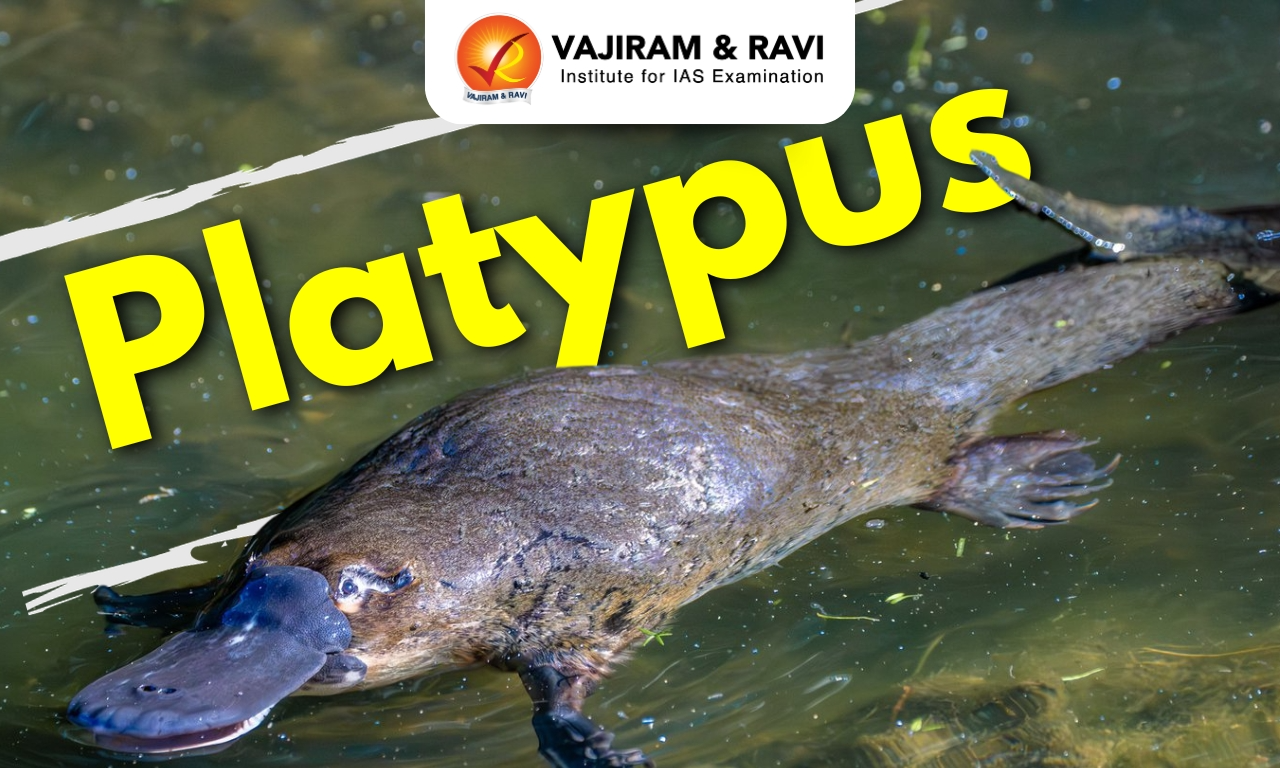
  • The platypus is a semi-aquatic egg-laying mammal endemic to eastern Australia.
  • Scientific Name: Ornithorhynchus anatinus 

Platypus Habitat

  • Platypuses occur in freshwater systems from tropical rainforest lowlands and plateaus of far northern Queensland to cold, high altitudes of Tasmania and the Australian Alps. 
  • When not foraging, the platypus spends most of the time in its burrow in the bank of the river, creek, or a pond.  

Platypus Features

  • The duck-billed platypus's head and body grow to about 38 centimeters and its tail grows to about13 centimeters long. 
  • Platypus is well adapted for a semi-aquatic lifestyle. 
  • Its streamline body and a broad, flat tail are covered with dense waterproof fur, which provides excellent thermal insulation. 
  • The platypus propels itself through the water by using its front, short, webbed limbs, and the partially webbed hind feet act as rudders. 
  • It uses its tail for storage of fat reserves and the strong claws on its feet for burrowing and moving on land. 
  • In addition, males possess a horny spur on their ankles, which is connected to a venom gland in the upper leg, making the Platypus one of the few venomous mammals. 

Platypus Conservation Status

It is classified as 'Near Threatened' under the IUCN Red List.

Source: EAR

Platypus FAQ's

Q1: What type of animal is the platypus?

Ans: It is a semi-aquatic egg-laying mammal.

Q2: Where is the platypus endemic to?

Ans: It is endemic to eastern Australia.

Q3: What type of body covering does the platypus have?

Ans: Dense waterproof fur.

Q4: What unique feature do male platypuses possess?

Ans: A venomous spur on their ankles, making the Platypus one of the few venomous mammals.

Q5: What is the conservation status of the platypus?

Ans: It is listed as Near Threatened under the IUCN Red List.

Panchayat Advancement Index 2.0

Panchayat Advancement Index 2.0

Panchayat Advancement Index 2.0 Latest News

Recently, the Ministry of Panchayati Raj released the Panchayat Advancement Index (PAI) 2.0 Report for the FY Year 2023–24.

About Panchayat Advancement Index 2.0

  • It is India’s first nationwide data-driven framework to assess Gram Panchayat performance.
  • It serves as a robust tool for evidence-based planning, performance monitoring, and incentivising Panchayati Raj Institutions.
  • It evaluates each of the more than 2.5 lakh Gram Panchayats across the country.
  • It is built on the framework of Localization of Sustainable Development Goals (LSDGs), which consolidates the 17 global SDGs into nine thematic areas relevant to Panchayati Raj Institutions.
  • Indicators Used : It used 150 indicators and 230 data points spanning nine thematic areas under the Localization of Sustainable Development Goals (LSDGs) –
    • Covering Poverty, Health, Child Welfare, Water, Environment, Infrastructure, Social Justice, Good Governance, and Women’s Empowerment.
  • Based on their composite PAI scores, Gram Panchayats are classified into five performance categories
    • Achiever (A+: 90 and above)
    • Front Runner (A: 75 to below 90),
    • Performer (B : 60 to below 75),
    • Aspirant (C: 40 to below 60),
    • Beginner (D: below 40)
  • It is prepared by the Union Ministry of Panchayati Raj.

Source: PIB

Panchayat Advancement Index 2.0 FAQs

Q1: Panchayat Advancement Index 2.0 was launched by which ministry?

Ans: Ministry of Panchayati Raj

Q2: What is the main purpose of PAI 2.0?

Ans: Evidence-based measurement of progress of Gram Panchayats towards achieving SDG localization

Mission SAKSHAM

Mission SAKSHAM

Mission SAKSHAM Latest News

Recently, the Reserve Bank of India (RBI) Governor launched a Mission for Urban Co-operative Banks.

About Mission SAKSHAM

  • The mission SAKSHAM (Sahakari Bank Kshamta Nirman) is a sector-wide capacity-building and certification framework for urban co-operative banks (UCBs).
  • It aims to enhance managerial and operational capabilities, improve compliance culture, and strengthen institutional resilience across UCBs.
  • It is a mission-mode, sector-wide and all-India capacity-building training initiative for UCBs, under which the RBI will conduct a large number of training programmes.
  • Features
    • Participant Goal: 1.40 lakh individuals across the UCB sector nationwide.
    • Target Groups: It targets board members, senior management, heads of risk, compliance and audit functions, and employees working in IT functions and other critical areas.
    • Delivery Model: Blended learning (in-person and digital) with a focus on regional language accessibility.
    • Collaboration: Designed with the Umbrella Organisation for UCBs and State/National Federations.
    • Core Objective: To improve compliance culture and strengthen the financial health of cooperative institutions
    • It focuses on establishing a sustainable, self-reinforcing ecosystem for systemic stability and the healthy growth and development of the UCB sector.

Source: BS

Mission SAKSHAM FAQs

Q1: Mission SAKSHAM – Sahakari Bank Kshamta Nirman was launched by which organisation?

Ans: Reserve Bank of India

Q2: What is the aim of Mission SAKSHAM ?

Ans: To enhance managerial and operational capabilities, improve compliance culture, and strengthen institutional resilience across urban co-operative banks.

Preah Vihear Temple

Preah Vihear Temple

Preah Vihear Temple Latest News

In a sad turn of events, Thailand and Cambodia are currently fighting over the centuries-old Preah Vihear Temple, dedicated to Lord Shiva.

About Preah Vihear Temple

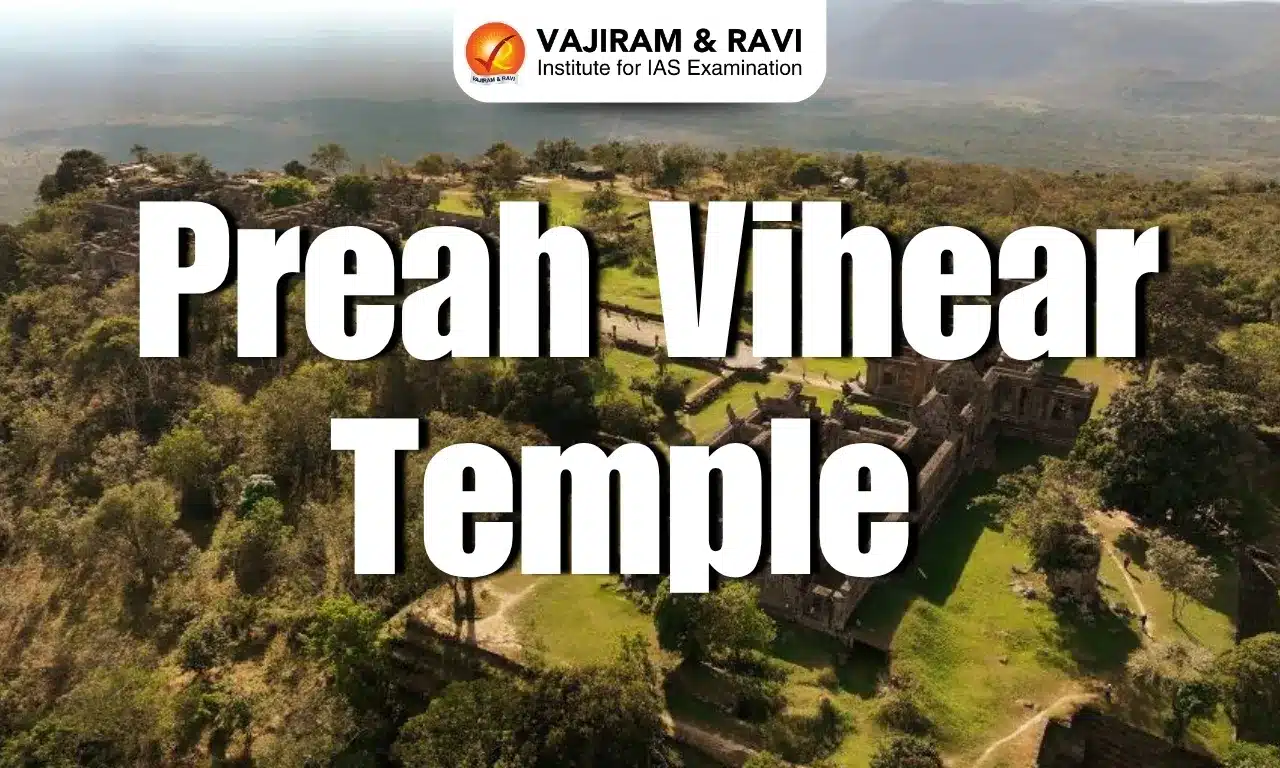
  • It is a Hindu temple located in the Preah Vihear Province, in the northern part of Cambodia.
  • It is situated atop a cliff on the Cambodia–Thailand border in the Dangrek Mountain range.
  • It is dedicated to Lord Shiva. 
  • It was built during the period of the Khmer Empire, in the eleventh and twelfth centuries.
  • It was built firstly by King Suryavarman I (1002-50) and then expanded upon by Suryavarman II (1113-50).
  • It was used by the ancient kings of Angkor for over 800 years. 
  • After the decline of Hinduism in the region, the temple gradually transformed into a Buddhist monument, which is why it features some Buddhist decorations.  
  • Due to its location, the Preah Vihear temple has been at the heart of the conflict between Cambodia and Thailand since the 19th and 20th centuries. 
    • In 1904, both countries signed a treaty granting Cambodia the right to occupy the temple. 
    • However, the Thai government contested the treaty and took control of the site. 
    • This led to a public protest by Cambodians in 1959. 
    • To resolve the issue, the International Court of Justice in The Hague ruled in 1960, affirming Cambodia's ownership of the temple.
  • In July 2008, Preah Vihear was designated a UNESCO World Heritage site.

Preah Vihear Temple Architecture

  • It is an outstanding masterpiece of Khmer architecture.
  • The temple is composed of a series of sanctuaries linked by a system of pavements and staircases over an 800-metre-long axis.
  • It features more than five successive gopuras
  • Unlike other structures of this kind, the gopuras here are connected by a long path and topped with multi-tiered platforms. 
  • Some of these gopuras have stone roofs, while others have wooden roofs.

Source: MSN

Preah Vihear Temple FAQs

Q1: Where is Preah Vihear Temple located?

Ans: It is located in Preah Vihear Province in northern Cambodia.

Q2: On which geographical feature is Preah Vihear Temple situated?

Ans: It is situated atop a cliff in the Dangrek Mountain range.

Q3: During which empire was Preah Vihear Temple built?

Ans: It was built during the period of the Khmer Empire, in the eleventh and twelfth centuries.

Q4: What was the International Court of Justice's verdict regarding the Preah Vihear Temple?

Ans: It affirmed Cambodia’s ownership.

Enquire Now